Why Your Pizza Stays Doughy Inside: Common Mistakes

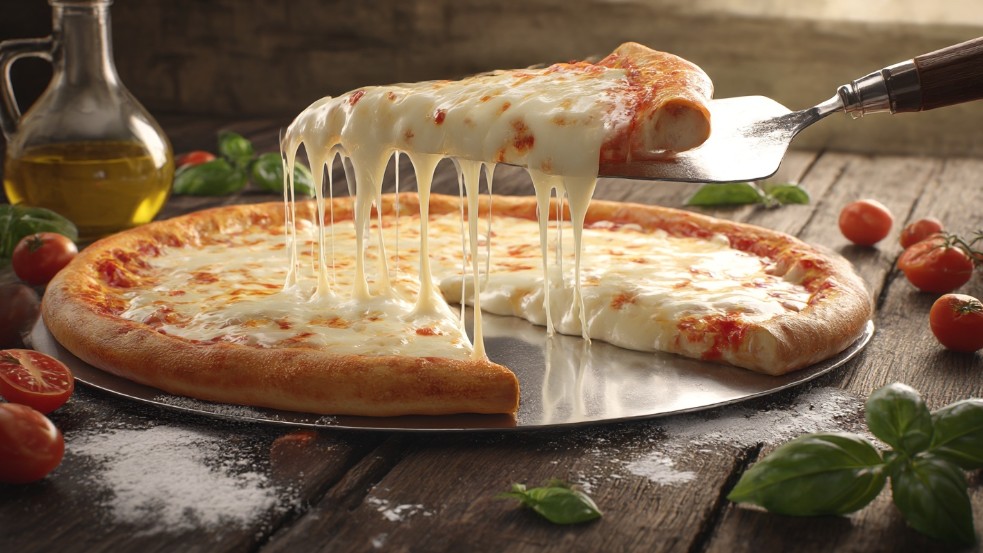
It happens: you pull a pizza out of the oven and the top looks perfect. The cheese is bubbling, the smell is unreal, and you’re ready to bite the edge straight off the peel. Then you slice it—and the middle is sticky and heavy, like it never really baked. Sound familiar? It’s extra annoying because the top is basically lying to you: it looks done, while the base and the center are doing their own thing.
Most people assume the recipe is wrong or their oven is “bad.” In reality, pizza usually doesn’t bake through for a few very down-to-earth reasons: temperature, moisture, thickness, cold toppings, and that moment when you decide “that’s enough.” And yes—rushing. Pizza really doesn’t like being hurried.
I’ve seen the same scene play out on home kitchens a hundred times: the dough is made with love, the toppings are generous, and then everything falls apart in the last 10 minutes. The most frustrating part? It’s not a “failure.” It’s a handful of small technical missteps that are easy to fix once you understand what’s actually happening.
Let’s talk about it like real people: how to figure out why your pizza is raw in the middle, what exactly is blocking it from baking through, and how to learn to read dough with your hands and your eyes so you’re not guessing.
How pizza actually bakes: heat, steam, and time
Pizza isn’t just “baking from the top and bottom.” A few processes happen at once: the base gets hit with direct heat from a stone or tray, the top cooks from hot air and radiant heat, and the center warms up more slowly because that’s where the moisture and toppings live.
When someone says “it didn’t bake through,” they usually mean one of three things:
- the bottom is pale and soft, with no crispness;
- the center of the dough is dense and sticky, almost gluey;
- there’s a wet layer under the toppings, like the dough “boiled.”
Here’s the key idea: heat always takes the easiest path. If there’s a lot of moisture on top (sauce, cheese, mushrooms), that moisture starts evaporating and steals energy. While water is evaporating, the surface temperature hangs around 100°C for a long time—but a good crust and proper dough structure need more than that. That’s why a pizza can look done (the cheese melted) while the dough hasn’t had time to set.
The way I think about it: the oven isn’t magic, it’s balance. Add too much “wet” and “cold,” and you take away the dough’s chance to spring up fast and dry out properly.
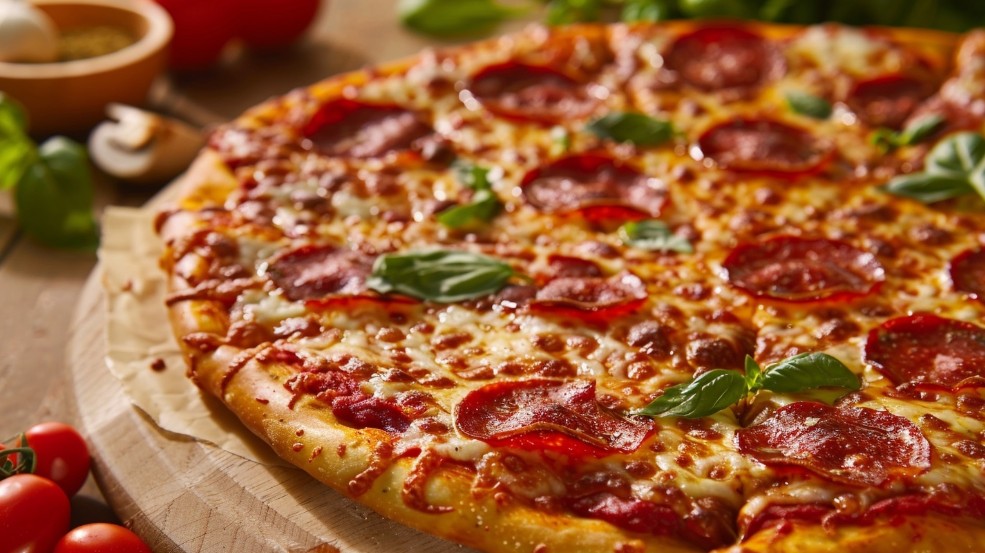
Signs your heat is working
You don’t need a thermometer to learn to “read” a pizza. A few clues are visible (and even audible):
- The rim has puffed up and looks airy with small bubbles—not flat like a sad crepe.
- The bottom, when you lift it with a peel or spatula, looks dry and gives a slight “grippy” resistance—not a damp smoothness.
- The sound: tap the crust—if it’s not dull but a little hollow, you’re on the right track.
- The smell: not just tomato-and-cheese, but a warm bready, slightly nutty aroma. That’s the dough actually baking, not just heating up.
If all you smell is cheese and tomatoes and none of that bready note, it often means the bottom didn’t get enough direct heat.
Temperature and preheating: a “hot oven” isn’t just the number on the dial
One of the most common reasons for raw dough is that the oven isn’t as hot as you think. The dial can say 250°C, but that doesn’t mean your tray, stone, or even the oven cavity has actually stored enough heat.
At home it often looks like this: the oven beeps that it’s ready, you slide the pizza in—and instead of a quick rise, it slowly dries out. The rim doesn’t “jump,” the bottom doesn’t set, and the toppings have time to release water. Hello, soggy center.
Why preheating solves half the problem
Pizza loves a strong start. The first minutes are critical. If the base gets hit with serious heat right away, the dough springs, the bubbles set, and moisture can’t seep down as easily.
Tip #1: I preheat longer than I “need” to. Not 10 minutes—30–45, especially if I’m using a thick tray, a stone, or cast iron. They need time to store heat; otherwise they act like a cold radiator that steals temperature right when you need it most.
Where to bake pizza: lower rack or middle?
If the bottom is underbaked, it’s not always “needs more time.” Often it’s “wrong spot.”
- If the pizza sits too high, the top browns fast while the bottom lags behind.
- If it sits too low without a properly preheated stone/tray, the bottom can burn in patches while the center still stays heavy because the heat is uneven.
Tip #2: if my oven runs weak, I start the bake a bit lower (to help the base set), then for the last 1–2 minutes I move it higher or switch on top heat to finish the cheese and rim. Not a universal rule, but as a technique—it works.
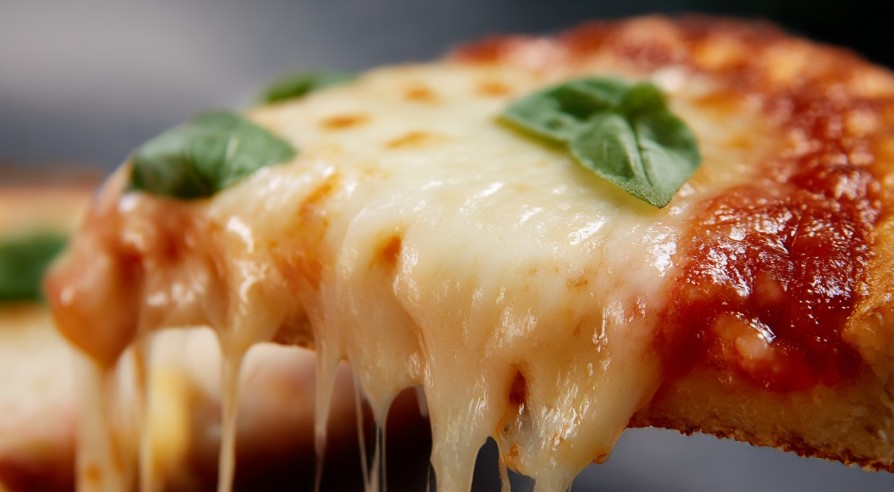
Dough that’s too thick or overworked: why the center stays gummy
There’s “sticky because it’s underbaked,” and there’s “sticky because the structure never formed.” The second one happens more often than people think.
If the dough is too thick in the center—or you’ve really mashed it down while shaping—it takes longer to heat through. But the bigger issue is that the air pockets that should create a soft, springy crumb don’t form (or they get crushed). The result is a dense layer that bakes slowly even at a good temperature and still feels raw.
I’ve got a classic story: a friend wanted “pizzeria-style” pizza but loved using a rolling pin. He’d roll it thin, then fold the edge to make a rim and press it down neatly. It looked tidy, but the dough turned into something like compressed fabric. The pizza came out with a gorgeous top and a rubbery middle. We changed one thing—less pressing, more hand-stretching—and the problem disappeared without any “secret” yeast tricks.
What the dough should feel like in your hands
This isn’t about perfection. It’s about control.
- The dough should feel springy: press a finger in and the dent slowly bounces back.
- The surface should feel alive—not a dry skin, and not sticky sludge.
- When you stretch it, it should give without tearing at the first move.
If the dough “melts” and clings to your hands even after a light dusting of flour, either it’s too wet for your flour, it’s under-fermented (not ready), or it’s been overheated/overhandled.
How it should be vs. what people often do
- How it should be: the center is a bit thinner, the rim is airier; you can feel there’s a “cushion” inside.
- What people often do: the center stays thick because they’re afraid of tearing; the rim gets pressed down “to make it even”; everything turns into one solid sheet.
Tip #3: when you shape the base, leave the center a little thinner than feels “safe.” The pizza will rise in the oven. A thick, raw center won’t magically fix itself.
Moisture from toppings: the sneakiest reason for a wet layer under the cheese
A pizza can be baked, yet still feel raw because of moisture. That’s when you bite in and there’s a slippery, slightly gluey layer under the toppings—like the dough didn’t finish, even though the bottom is already browned.
Most of the time it’s not the yeast or the oven. It’s toppings releasing water faster than the dough can “seal” itself.
High-moisture toppings (and you don’t always suspect them)
- fresh tomatoes, especially thinly sliced;
- button mushrooms and most other mushrooms;
- fresh mozzarella in brine, if you don’t dry it;
- frozen vegetables that “weep” as they heat;
- sauce that’s too thin—or simply too much sauce.
When that water comes out, it doesn’t vanish instantly. It turns into steam, rises, condenses under the cheese, and some of it soaks into the dough. If the base hasn’t set yet, you get that “boiled” middle effect.
How to control moisture without going overboard
I’m not a fan of the “dry everything into a cracker” approach. Pizza should be juicy. But juicy isn’t a puddle.
- Pat dry what’s genuinely wet: mozzarella in brine, tomatoes, anything pickled. Five minutes on paper towels is enough.
- Don’t spread sauce in a thick layer. Sauce should stain the dough, not float on it.
- Slice mushrooms not too thick: thick pieces release water longer, and you end up with a “wet peak” in the center.
Tip #4: if you love lots of toppings, make them “smart”: less watery stuff, more flavor without extra liquid (sun-dried tomatoes, roasted veg, well-squeezed greens). It’s not about rules—it’s about balance.
When a pizza won’t bake through, I almost always look at the moisture on top first, not the dough. The dough is often “guilty” only because it didn’t have time to protect itself.
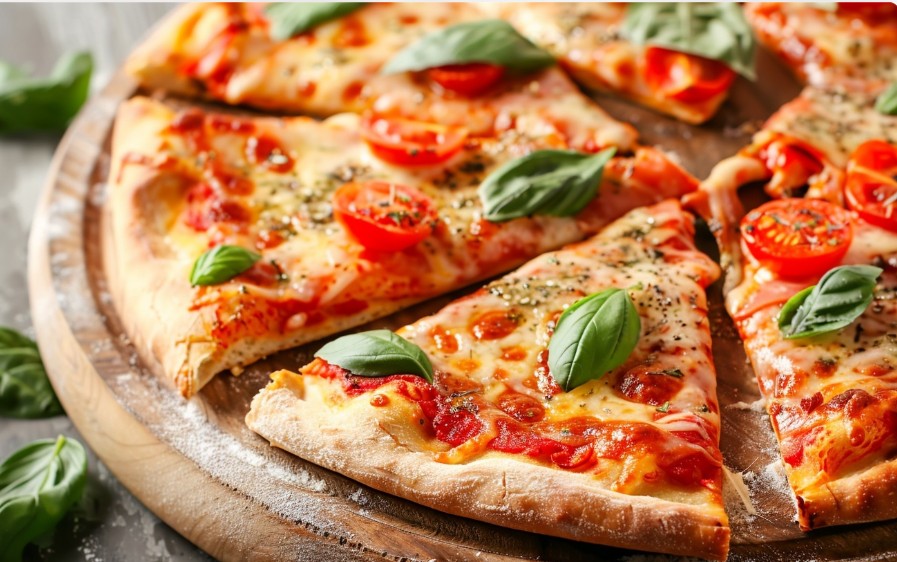
Cold toppings and cold dough: why everything slows down in the oven
Another home-kitchen classic: dough straight from the fridge, mozzarella just pulled from brine, cold salami, cold sauce. You assemble fast (totally logical), slide it into the oven—and end up with a beautiful top and a pale, underdone base.
Why? Because the oven spends the first minutes warming a cold mass instead of baking. And pizza lives or dies by the start.
I remember making pizzas for friends assembly-line style: pull one out, build the next. The worst one was always the last pizza—when the dough had chilled again from waiting and the toppings were sitting in a cold pile. It looked fine, but it sliced with resistance and had that heavy center.
What to do at home if everything is coming from the fridge
- Let the dough sit at room temperature so it becomes elastic, not stiff and “glassy.”
- For mozzarella in brine, at least dry it and tear/slice it ahead of time so it’s not an icy lump.
- Don’t leave an assembled pizza sitting on the counter for 20 minutes. It starts getting soggy before it even hits the oven.
Tip #5: I assemble pizza at the last possible moment. First the oven and baking surface preheat, then I shape the base, and only then do I add toppings. It’s a small thing, but it makes a big difference.
Overloaded pizza: when “generous” means “it won’t bake through”
There are two kinds of generous. One is enough toppings, spread evenly, with respect for the dough. The other is a mountain of everything in the fridge. The second one almost always ends with a raw center.
The issue isn’t “too many toppings” in general. The issue is that they create a heat shield. Hot air can’t reach the dough properly, moisture can’t evaporate fast enough, and the cheese blankets the surface. The bottom bakes, the top melts, and the middle stays stuck in limbo.
Signs you’ve gone too far with toppings
- the center sags when you pick up a slice;
- when you cut it, the toppings slide and you see a wet layer underneath;
- the rim is already getting dark, but the cheese in the center still looks pale and “milky,” with no light browning.
I’m not here to police how you top your pizza. But I will say this: if you want more flavor, it’s better to make it concentrated, not bulky. Then the pizza bakes through and tastes rich—not heavy.
How it should be vs. what people often do
- How it should be: you can still see dough between toppings; there’s some “air.”
- What people often do: a solid carpet of cheese and toppings; the dough is hidden; steam has nowhere to escape.
Tip #6: if your hand keeps reaching for “just a little more,” make two less-loaded pizzas instead. They’ll bake faster, and you won’t be stuck trying to “save” one thick one.
Beginner mistakes: what specifically ruins bake-through
I’ve collected this list over years—not from books, but from real kitchens where people genuinely try and still step on the same rakes.
- A cold tray. You put the pizza on metal that just came out of the cupboard. The bottom loses immediately.
- Too much flour under the dough. It feels like insurance against sticking, but extra flour burns, turns bitter, and prevents even contact with the hot surface. Sometimes it also creates a “slippery” layer that keeps the dough from setting well.
- Rolling pin + heavy pressure. You squeeze out the air and end up with a dense structure that takes forever to bake.
- Assemble and let it sit. Sauce starts soaking into the dough before it even goes in the oven, so you’re starting with a wet base.
- Judging only by the cheese. Cheese melted = done. Nope. Cheese melts quickly even at temperatures where the dough is still underbaked.
- Too low a temperature for too long. Pizza doesn’t always want “longer.” At lower heat it dries more than it bakes, and it can stay pale and heavy.
I used to make the “longer is better” mistake myself. I’d keep the pizza in until the rim was basically a crouton, and the center was still wet. Then it clicked: I wasn’t giving it the right start. Once I changed that habit—max preheat first, timing second—everything got easier.
What to do if your pizza is already underbaked: fix it without panicking
The worst options are throwing it away or forcing yourself to eat it. You can bring a pizza back if you stay calm and figure out what’s wrong: the bottom, the center, or moisture under the toppings.
If the bottom is pale and soft
The problem is weak contact with heat or a poor start.
- Put the pizza back in the oven lower, closer to the heat source.
- If you have a bottom-heat setting, use it briefly so you don’t dry out the top.
- If the pizza is on parchment, it sometimes helps to carefully pull the parchment out from underneath halfway through: direct contact with the hot tray is better. Only do this if the pizza has already set and won’t slide apart.
If it’s wet under the toppings but the bottom is already browned
This one is moisture. You need to evaporate it.
- Move the pizza a bit higher so there’s more hot-air circulation over the top.
- If the top is already dark but the wet layer remains, sometimes it’s better to take the pizza off the tray for 1–2 minutes and set it directly on the rack so steam can escape from below and above.
If the center is sticky and heavy
This is the toughest case, because it’s often about thickness or structure.
- Give it more time, but watch the rim so it doesn’t turn into a dry ring.
- If the top is already on the edge and the center still won’t catch up, next time reduce the thickness in the middle and cut back on toppings. Sometimes you can “bake it through,” but it’s better not to end up there.
When something goes wrong, I always ask myself: do I need more heat from below, or do I need to get rid of moisture on top? Those are two different problems, and they require two different moves.
Patience and timing: how to slow down without drying it out
Pizza is a funny thing: it’s fast, but it hates chaos. Most “failures” happen not because you can’t cook, but because you didn’t let the process do its job at the right moment.
Two places where patience really pays off:
- Before baking: give the oven and baking surface time to fully preheat; let the dough become elastic if it was cold.
- After baking: let the pizza sit for 2–3 minutes before slicing. Yes, it’s hard. But in those minutes, steam redistributes, the cheese stabilizes a bit, and your slice won’t turn into a slippery pile.
I used to laugh at the whole “let it rest” thing—until I started slicing pizza immediately for kids. The result: wet center, everything sliding off. Once I waited just a couple of minutes, the difference was obvious: the dough holds its shape, the bottom stays crisp, and it doesn’t soften under its own steam.
Tip #7: if you struggle to judge doneness, don’t look at the cheese—look at the rim and the bottom. Cheese can be “ready” long before the dough is. The bottom and crust, though, rarely lie.
If your pizza won’t bake through, it’s almost always a combo of two things: either it didn’t get enough heat at the start (especially from below), or there was too much moisture/cold on top. Dough can trip you up too—a thick center, crushed bubbles, rushing the shaping—but that’s not a verdict. It’s a skill you build by learning what the dough feels like in your hands.
I’m curious: do you usually struggle with a raw bottom, or with that wet layer under the toppings? Describe what your “underbaked” pizza looks like—and what you see on the cut.