How to Store Fresh Herbs the Right Way

You know how it goes: you buy a bunch of dill or parsley and it smells so good you want to chop it straight into a salad. Then two days pass, you open the fridge, and instead of perky leaves you’ve got a limp, damp mess with dark spots and that sad “yep, it’s too late” smell. And you’re standing there with the bag in your hand, annoyed—not at the herbs, but at yourself. Again.
I know this story well. In the kitchen, herbs are that small-but-important detail: they won’t save a bad dish, but they make an okay one feel alive. Which is exactly why it hurts to throw them out. Most of the time the problem isn’t your fridge and it isn’t “bad” parsley—it’s that we store herbs like they’re carrots: toss them in the drawer and forget about them.
Herbs are delicate. They either dry out or they rot. What they need is balance: a bit of moisture, a bit of airflow, minimal pressure, and the right temperature. No science project, no complicated systems—just a few simple rules that actually work in a normal kitchen, even if your fridge is packed with pots and containers.
Why herbs spoil so fast (and what that means for storage)
Herbs aren’t really a “product”—they’re basically a living plant that’s just been cut. They keep breathing, losing moisture, and wilting. The leaves are thin, the stems are like little straws: moisture escapes quickly, and too much moisture just as quickly kicks off rot.
I boil herb problems down to three enemies: dryness, moisture with no airflow, and physical damage (when they get crushed, bent, or snapped). Once you understand those three, everything else starts to make sense.
Dryness: herbs wilt, but they’re still “alive”
When herbs dry out, they go limp, the leaves look dull, and the tips curl. It’s not a disaster yet—sometimes you can perk them up in cold water. Still, it’s better not to let it get that far, because the flavor and aroma will fade either way.
Moisture with no airflow: slime, dark spots, and that “off” smell
The most common scenario: you wash the herbs, toss them wet into a bag, tie it up—and a day later you’ve made a mini greenhouse. Warm, humid, barely any air. Leaves start to darken, they get slippery, and the smell turns musty. At that point you don’t want them in borscht or in a salad.
Physical damage: herbs hate being squashed
Dill, parsley, and cilantro can take a bit more. Basil, mint, and green onions are more fragile. If you pin them under a tub of sour cream or trap them in the fridge door, the bruised spots are the first to turn black. So it’s not just where you put them, but how.
I always say at home: herbs don’t get stored “somewhere.” They need a little dedicated spot—like you’d do for your glasses—so you’re not digging around and crushing them.
How to choose herbs that will actually last until the end of the week
Good storage starts at the store, not in your fridge. I’ve watched people grab a bunch “because it smells nice,” even though it’s already tired: soft leaves, kinked stems, wetness at the bottom. You can vacuum-seal herbs like that at home and they still won’t last.
At a market: look at the stems, not the pretty top
The top of the bunch is almost always the best-looking part—that’s what’s on display. The bottom is where the truth shows up.
- The cut end should look fresh—not dark and not slimy. If it’s brown and wet, the herbs have been sitting around.
- Stems should feel springy. Gently bend one: fresh stems bounce back, old ones either snap with a dry crunch or bend like rubber.
- Smell should be clean and herbal. Any sourness or swampy note—skip it.
- Moisture on the bunch is suspicious. Herbs are often misted to look fresher, but if they’re wet all the way through, they’ll spoil faster.
At the supermarket: packaging can be a trap
Plastic clamshells and bags with “breathing” holes look neat, but I’ve brought home arugula that looked perfect and turned into a dark mush the next day. The reason is usually simple: too much moisture trapped inside.
- Check for condensation on the film. Droplets are a sign the greens are sweating.
- Look at the bottom of the pack: if it’s wet or you see dark leaves, spoilage has already started.
- Notice how tightly it’s packed. If it’s compressed, the leaves on the bottom will go bad first.
Seasonality and common sense
Some herbs simply last longer in season because they were cut yesterday, not shipped across the country. In spring and early summer, dill and parsley often keep better. In winter they’re more likely to be watery and “cottony,” especially greenhouse-grown bunches.
And about price: sometimes it’s smarter to buy a smaller bunch that’s truly fresh. A big cheap “broom” sounds like a deal until half of it ends up in the bin. I’m not into saving money at any cost—I’m into buying what you’ll actually use.
First thing at home: wash or don’t wash? (and why it matters)
This is where people tend to go all-in in the wrong direction: either they wash everything immediately, or they wash nothing and then panic when they need to chop herbs fast.
My practical rule is: wash them if you’re prepared to dry them properly. If you’re not, store them dry and wash right before using. Wet herbs in a bag are almost guaranteed trouble.
When I wash right away
If the herbs are from a market and there’s sand, soil, or little bits of debris, I wash them. But not “under the tap and back into the bag.” I do it properly: a bowl of cold water, dunk the herbs, swish gently, let the grit sink, then lift the herbs out.
Next comes drying. Without this step, the whole thing is pointless.
- Best option: a salad spinner. Not a gimmick—genuinely useful if you buy leafy greens often.
- No spinner? Spread the herbs on a towel, cover with another towel, and press gently. Don’t rub, don’t wring.
- Let them sit out for 10–15 minutes so any lingering droplets can evaporate.
Tip: I dry herbs in small batches. If you dump the whole bunch into a pile, moisture hangs around longer and the leaves on the bottom get crushed.
When I don’t wash
If supermarket herbs look clean and dry, or I know I’ll use them within 1–2 days, I often don’t wash them. I store them dry, then quickly rinse and pat dry only what I need right before chopping. It lowers the risk of spoilage from extra moisture.
Green onions and dill: different personalities
Dill and parsley like “a little moisture and lots of air.” Green onions are a separate story: they often go slimy on the greens if you store them damp. So I wash green onions less often and dry them even more carefully.
Three reliable ways to store herbs in the fridge
I don’t believe there’s one “correct” method for every situation. Maybe your fridge is tiny, maybe you’ve got a big family, maybe you cook every other day. So here are three methods I actually use. They’re simple, don’t require special containers, and each one suits different herbs.
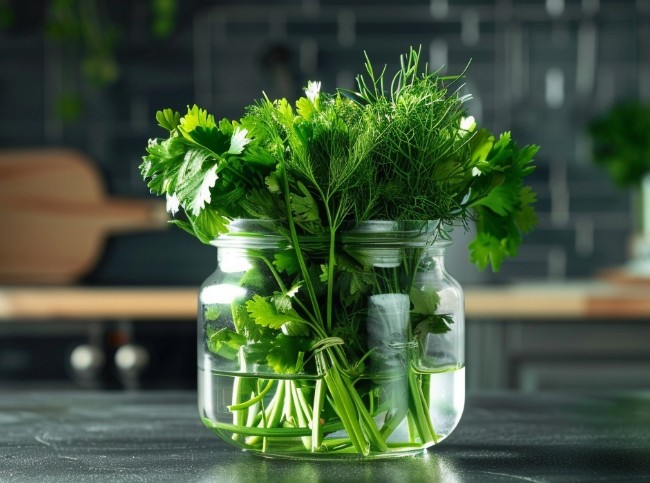
Method 1. “Bouquet in a jar” — when you want herbs upright and within reach
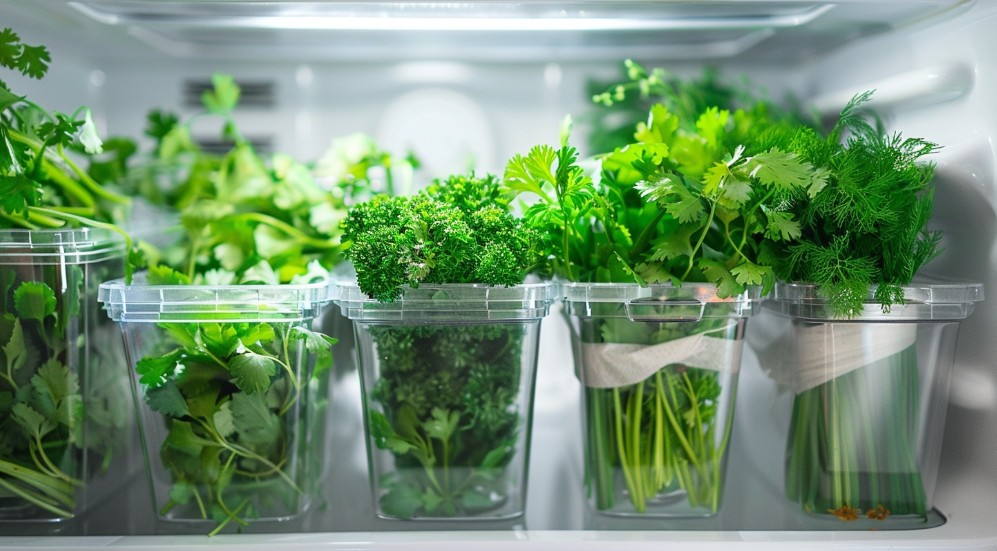
This is my favorite for parsley, dill, cilantro, celery leaves, and sometimes mint. It works because the herbs stand like flowers and drink through the stems. The leaves stay crisp and the aroma stays bright.
- Trim 0.5–1 cm off the stems (a fresh cut helps them “drink”).
- Pour 2–3 cm of cold water into a jar.
- Stand the herbs in the jar like a bouquet.
- Cover loosely with a bag, but don’t tie it airtight—think of it as a light “hood” with some airflow.
- Place it in the fridge where nothing will press on it.
Change the water every 2–3 days. If it turns cloudy or smells off, change it immediately. One more thing: if the leaves touch the back wall of the fridge and partially freeze, they’ll turn black. So keep the jar closer to the door or in a spot that doesn’t run icy.
A quick story: years ago in a restaurant we kept parsley in a hotel pan under plastic wrap. It was… fine. But once we switched to “bouquets,” we stopped tossing half the bunches. Best part: nobody had to “hunt for herbs” anymore—they were right there, like a tool.
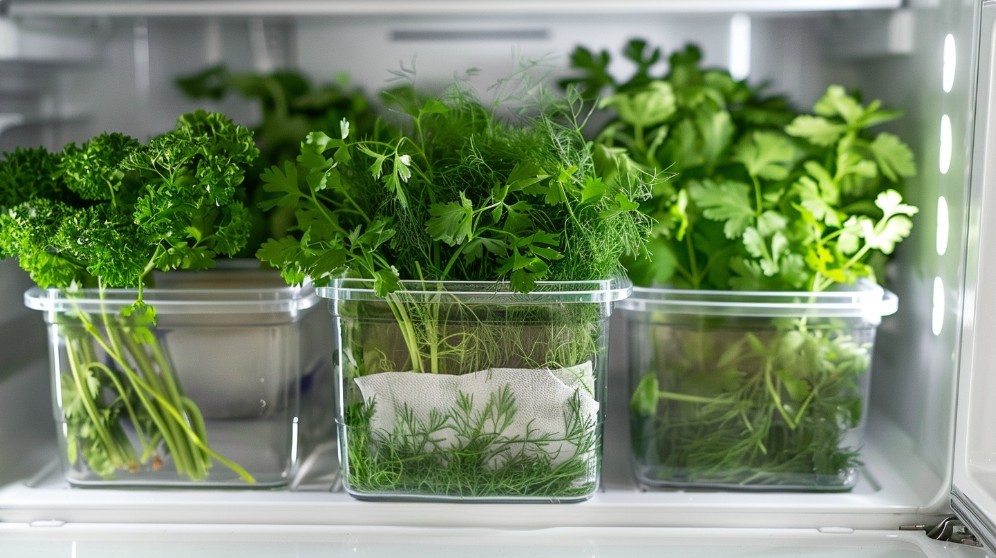
Method 2. Paper towel + container/bag — for leafy greens
Arugula, spinach, salad mixes, delicate dill, even cress—anything that turns soggy easily. The goal here is different: absorb excess moisture without drying the leaves into crunch.
- The greens should be dry (or at least not dripping).
- Line the bottom of a container or bag with a paper towel.
- Add the greens loosely—don’t pack them down.
- Top with another paper towel.
- Close the container or bag, but leave minimal airflow (don’t “hand-vacuum” it).
Swap the towel if it gets wet. It’s a small thing, but it genuinely buys you a few extra days.
Tip: if your greens start to “sweat” in the bag, don’t wait. Open it up, let it air out for 5 minutes, and replace the towel. It often saves the whole batch.
Method 3. Wrap in a slightly damp towel — when you need the “golden middle”
I like this for dill, parsley, cilantro, and sometimes green onions. It’s simple: the towel provides a little moisture without creating a swamp, and the herbs can still breathe.
- Use a clean kitchen towel or a sturdy paper towel.
- Dampen it lightly (it should feel moist, not drip).
- Wrap the herbs loosely, like a blanket—not tight.
- Place in a bag or container, not fully airtight.
If the towel turns wet after a day, replace it. If it dries out and the herbs start wilting, dampen it again.
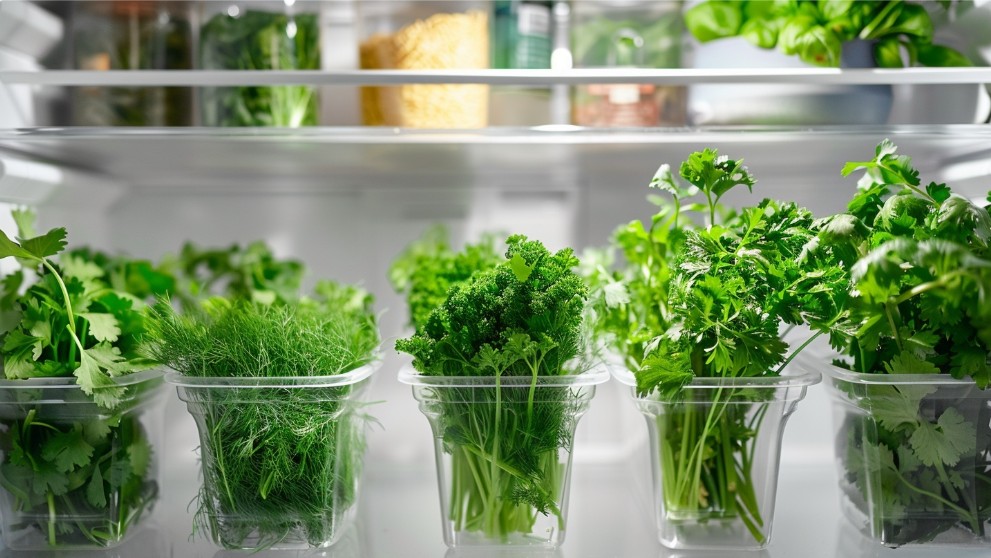
Common mistakes: why herbs die even in a “good” fridge
Honestly, most herb failures aren’t about temperature—they’re about small habits. I’ve made every one of these mistakes myself, until I got tired of throwing away money (and my mood).
Mistake 1. Leaving herbs in the store bag “as is”
That thin produce bag is a trap. It either steams the herbs (if there’s moisture inside) or dries them out (if it’s open and your fridge air is dry). Plus the herbs get crushed into a ball. If you’re short on time, at least open the bag at home, let them breathe, and move them into something more sensible.
Mistake 2. Washing and not drying
The most painful one. Water clinging to leaves is basically a spoilage accelerator. Moisture needs to be controlled: either on the stems in a jar, or in a towel you can replace.
Mistake 3. Storing herbs in the coldest spot
Herbs hate freezing. After they get chilled too hard, they turn dark, watery, and unpleasant in texture—especially basil and mint. If your fridge has “personality” and things freeze near the back, don’t put herbs against the rear wall.
Mistake 4. Storing herbs next to strongly scented foods
Onions, garlic, and some fruits can overpower herb aroma. Herbs absorb smells eagerly. If your dill suddenly smells like apples, it’s not magic—it’s proximity.
Mistake 5. Buying too much “because it’ll come in handy”
I get the logic. But herbs aren’t rice. They don’t like “later.” If you cook 2–3 times a week, it’s often better to buy two smaller bunches a few days apart than one giant one. That’s the kind of “savings” you feel in the trash can, not in your wallet.
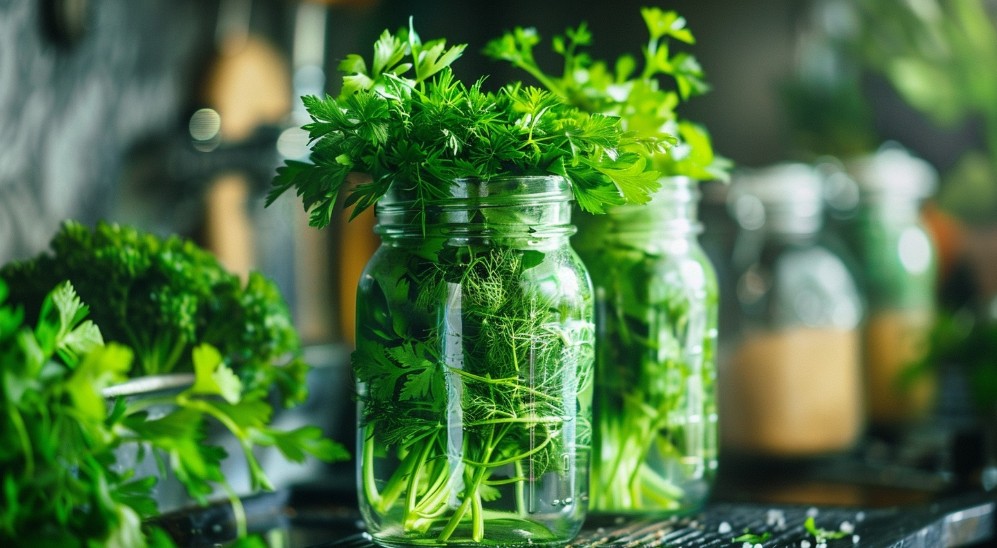
How to keep herbs fresh for 2–7 extra days: simple tricks (no magic)
Here are the things I actually do in my kitchen. Not all at once—I pick what fits the situation.
- Trim the stems before storing in water. Fresh cut = better water uptake.
- Don’t pack herbs tightly into a container. Air is your friend—when it’s dry and in moderation.
- Replacing the towel is a tiny step with a big payoff. A wet towel = greenhouse.
- Air it out: if you see condensation, open it for a few minutes, wipe the lid/film, and let the moisture escape.
- Separate delicate from sturdy. Don’t put mint under a heavy bunch of parsley—mint bruises and blackens fast.
- Keep herbs where you can see them. I put the jar near the front of the shelf. What you see, you use—and it doesn’t have time to spoil.
A quick story: I had a phase where herbs spoiled constantly. I blamed the fridge. Turns out it was simpler—I hid them in the bottom drawer “so they wouldn’t be in the way.” They were out of sight, out of mind. I moved them into a jar on a shelf, and the herbs started “disappearing” in the good way, because we actually ate them.
Different herbs, different rules: dill, parsley, cilantro, basil, mint, green onions
One reason internet advice doesn’t work is that it says “herbs” as if they’re all the same. They’re not. They’re different—like people. Here’s a quick guide to the most common ones.
Dill
Dill likes either a jar of water or a damp towel. It wilts quickly from dryness, but it turns soggy even faster in a bag if it’s wet. If your dill is very fine and delicate, the towel + container method is usually best.
In cooking, dill gives up its aroma easily, but long heat makes it taste flat. So I often add it at the end—meaning I use less, and the bunch lasts longer.
Parsley
Parsley is tougher. It does great in a jar. The leaves are sturdier, so it’s less bothered by slight drying. But if you crush it, it bruises into dark spots.
Cilantro
Cilantro can be fussy: strong aroma, delicate leaves. I store it like a bouquet and cover it loosely with a bag. If cilantro starts smelling “not quite right,” that’s usually your first sign the jar water isn’t fresh anymore or some leaves got too wet.
Basil
Basil is its own star. It doesn’t like the cold. In the fridge it often turns black, especially if it touches the cold wall or sits wet. If you only have a little basil and you’ll use it in 1–2 days, keep it at room temperature like a bouquet in water, away from sun and the stove. If it absolutely has to go in the fridge, store it dry in a container with a towel, in the warmest zone (usually closer to the door).
A quick story: I once “stored” basil like parsley—washed it, put it wet into a bag, and into the fridge. Overnight it turned black, like it was personally offended. Since then, basil either lives on the counter or goes straight into dinner.
Mint
Mint bruises easily and blackens from handling. It does well in a container with a dry towel (or barely damp), loosely arranged. It can also stand in a jar, but the leaves are delicate—make sure the bag on top isn’t pressing down.
Green onions
Green onions often spoil by turning slimy. I keep them dry, wrapped in a paper towel, in a bag with a little airflow. If your onions have the white part and roots attached, you can stand them in a jar with just 1–1.5 cm of water—but watch that the water doesn’t rise too high, or they’ll start to rot.
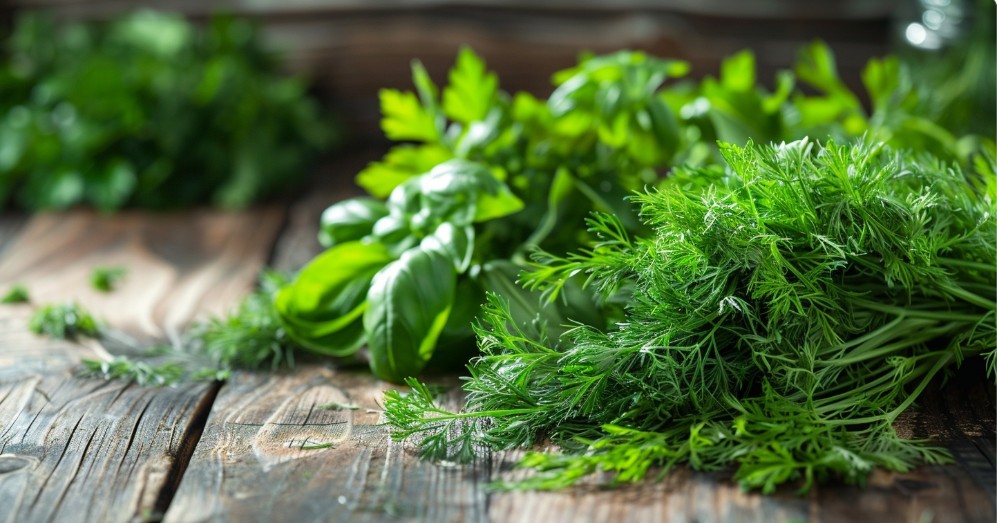
How to tell if herbs are still okay (and how to revive them fast)
Not all limp herbs belong in the trash. Sometimes they’re just dehydrated. Other times, spoilage has started and you can’t undo it. I look at three things: smell, sliminess, and color.
- Smell: if the aroma is just weaker, that’s fine. If there’s sourness, mustiness, or that “wet rag” vibe, I don’t risk it.
- Texture: a slippery surface is a bad sign. Softness without slime can often be saved.
- Color: a few dark leaves—toss those and keep the rest. Widespread darkening means the process is underway.
A quick “revive” for wilted herbs
If parsley or dill has wilted, I do this: a bowl of very cold water (you can add a few ice cubes), soak the herbs for 5–10 minutes, then lift them out and dry thoroughly. They often perk up noticeably—the leaves stand up and the aroma comes back.
Important: this works when herbs are wilted, not starting to rot. After a “bath,” herbs that are already going bad will get worse, because you’re adding moisture where moisture is already the problem.
Tip: if you revive herbs in water, don’t skip the drying step. Otherwise you’re just moving the problem to tomorrow.
When to pay more (and when not to): bunches, mixes, and “premium” packaging
Herbs are one of those products where marketing loves to play: “eco,” “premium,” “washed salad,” “ready to eat.” Sometimes it really is convenient. But it’s not always worth it.
A market bunch vs packaged herbs
A market bunch often lasts longer because it hasn’t been “handled” by packaging as much. But it can be dirtier—so you’ll need to wash and dry it. Packaged herbs save time, but they often trap more moisture inside, and that’s what shortens their life.
I’ll pay more for packaged herbs when I know I need speed (for a busy work week, for example). But even then, at home I still open the pack, check it, wipe away condensation, and re-pack with a towel. Otherwise there’s not much point.
Fresh herbs are one of the most important ingredients in so many dishes. They add aroma, color, and that clean, fresh taste—especially in lighter, summery food. That’s why it’s worth knowing how to store them properly so dill, parsley, or basil stay juicy for as long as possible. By the way, if you’re looking for ideas on where to use up fresh herbs, take a look at 10 of the best salads made with fresh ingredients—herbs really shine in recipes like that.
“Ready to eat” doesn’t mean “ready to store”
This is the key idea. Even if salad greens are “washed,” they can still be damp. And moisture in a closed box is the fastest route to slime. So the rule is simple: if you see droplets, let them go. A towel on the bottom/top and you’re already ahead.
If I had to sum it up: herbs last longer when you control two things—moisture and air. You don’t need expensive containers or complicated rituals. Pick a good bunch, don’t keep it wet in a bag, and give it either a “bouquet in water” setup or a dry towel that absorbs the excess.
So what usually happens to your herbs—do they dry out, turn black, or get slimy? Tell me in the comments which one (dill, basil, green onions) and how you store it now, and I’ll suggest what you can tweak without buying anything extra.