

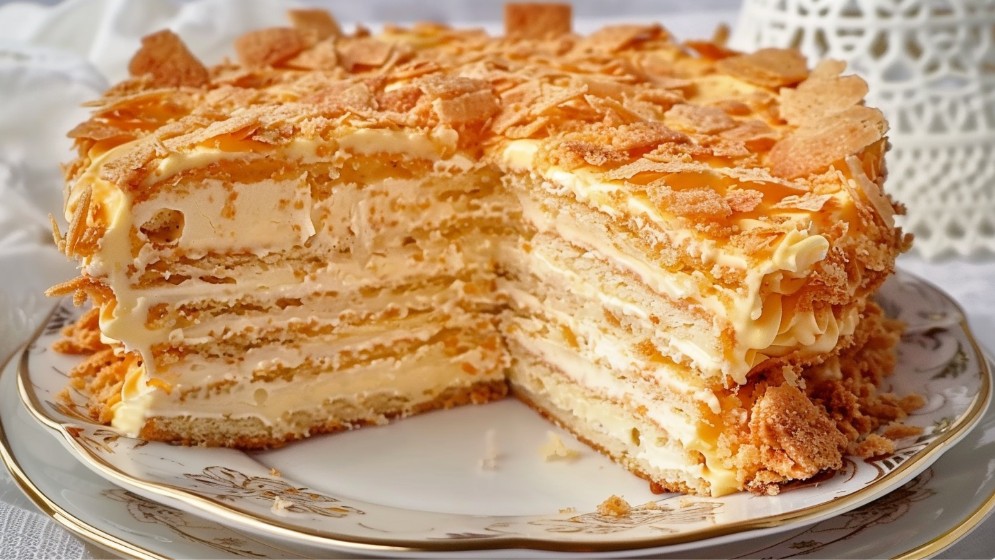
Those neat, thin triangles cut from a tall stack of layers look party-ready even without fancy decorating. The pastry bakes fast, but you do need to get into a rhythm: while one tray is in the oven, the next round is already rolled out. The custard is cooked until it’s thick enough to leave a clear trail from the whisk, then cooled so it won’t slide between the layers. And that crumb topping? It seems like a small thing, but it covers the edges and gives you that “right” texture. The best part is the next day, after the cake has had time to settle for 12 hours and your knife glides through with barely any resistance. Right before serving, dust with icing sugar, then let the slice sit at room temp for 10 minutes—the vanilla really opens up.
In this recipe, you’ll learn
- Why you’ll love this recipe
- Tips before you start
- What to look for when choosing ingredients
- Secrets to a perfect Napoleon cake
- How to serve Napoleon cake
- Nutritional notes
- Recipe variations
- Questions & answers
- Common mistakes
Why you’ll love this Napoleon cake recipe
After the first spoonful, it’s that quiet kind of satisfaction—crisp layers giving way to creamy custard. Once the cake rests for 12 hours, the layers settle and every slice cuts cleanly, no sliding around. Vanilla and real butter bring a rich flavour without turning it into a sugar bomb. Plus it’s practical: one big cake comfortably serves 10–12 people.
- Lots of thin layers
- Silky vanilla custard
- Crisp edges after resting
- That buttery, vanilla aroma
- Slices beautifully the next day
Tips before making Napoleon cake
If your kitchen runs warm, the butter in the dough softens too quickly and the layers can bake up flat. That’s when you lose the flakiness, and the edges brown before the middle is done. Easy fix: work in batches and keep the dough in the fridge for 30 minutes between rolling. One more small thing—dust the counter and rolling pin lightly with flour, but don’t bury it in flour, or the layers can turn tough.
- Chill the dough between roll-outs
- Roll the layers to about ~2 mm
- Dock each layer with a fork
- Bake on baking paper—no oil
- Let the custard cool completely
What to look for when choosing ingredients for Napoleon cake
Butter should smell clean and creamy and feel firm—not soft and greasy—so the layers puff properly in the oven. For the custard, milk at 2.5–3.2% works best: you get that smooth, velvety texture without it tasting watery. And vanilla should be fragrant even before you add it—if it’s faint in the bottle, it’ll disappear in the custard.
Butter
82% fat, cold; when you cut it, it should look matte, not weepy with water droplets.
Wheat flour
Fine/plain flour; sift once to keep the layers lighter.
Milk
2.5–3.2% fat; no off smells—ideally not UHT if you can help it.
Eggs
Large; richer yolks give the custard a warmer colour.
Vanilla
Vanilla extract or paste; if using vanillin, go easy—it can taste bitter if overdone.
👉 chocolate éclairs with ganache are perfect with a cup of tea
Secrets to a perfect Napoleon cake
Patience, honestly. Cold dough and quick hands keep the pastry flaky, and steady oven heat gives you evenly coloured layers. Custard likes medium heat and a nonstop whisk—do that and it turns out glossy and smooth, no lumps.
- Keep the dough cold at all times
- Bake the layers to an even golden colour
- Cook the custard until it leaves a clear whisk trail
- Assemble only with fully cooled custard
- Press the cake gently with a light weight
How to serve Napoleon cake
On a lazy Sunday afternoon, pull the cake from the fridge about 15 minutes before slicing. Serve thin pieces on chilled plates, with hot tea or coffee on the side.
- Finish with crumbs and a dusting of icing sugar
- Add a few fresh raspberries
- Pair with a hot espresso
- Top with thin flaked almonds
- Set out a little jug of caramel sauce
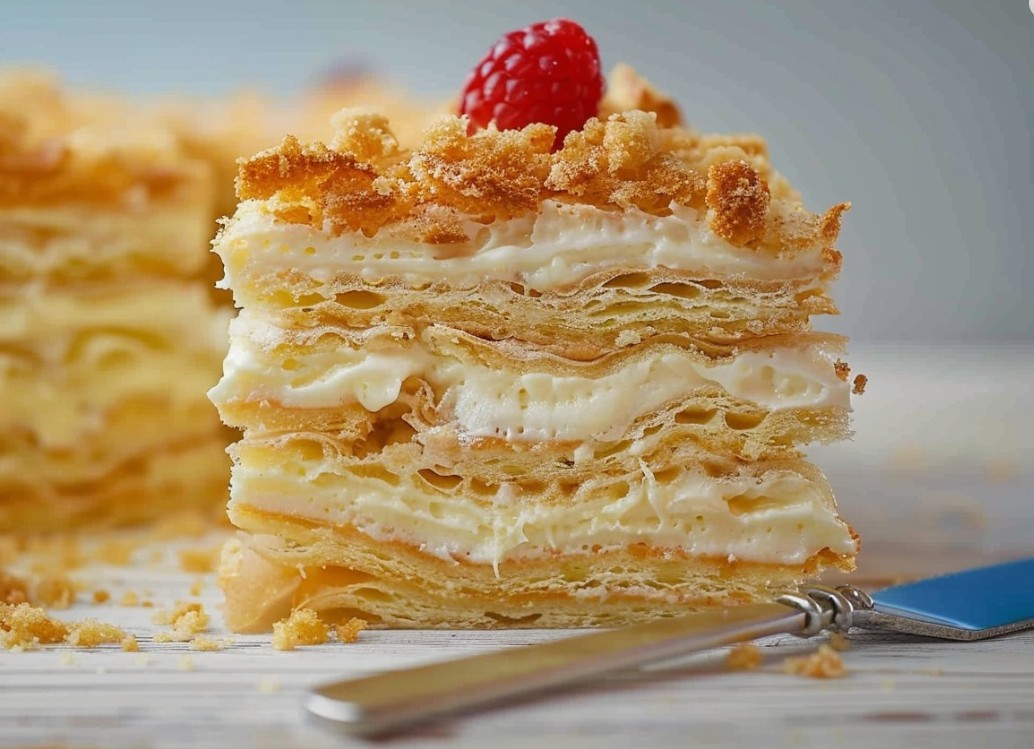
Napoleon Cake
Ingredients
- 600 г Wheat flour sifted
- 400 г Butter 82% very cold, cut into cubes
- 2 шт Eggs large
- 1 ст. л. Vinegar 9%
- 200 мл Water ice-cold
- 1 щіпка Salt
- 1000 мл Milk 2.5–3.2%
- 220 г Sugar
- 6 шт Egg yolks
- 60 г Cornstarch
- 120 г Butter 82% soft
- 2 ч. л. Vanilla extract or vanilla paste
- 1 ст. л. Icing sugar for dusting
Method
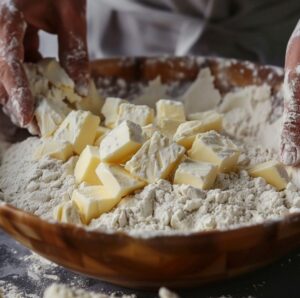
 Mix the flour with the salt. Add the very cold cubed butter and rub it in until you get crumbs with little butter “peas” about 3–5 mm. In a separate bowl, whisk the eggs with the vinegar and ice-cold water, pour it in, and quickly bring the dough together (don’t overwork it), about 3 minutes.
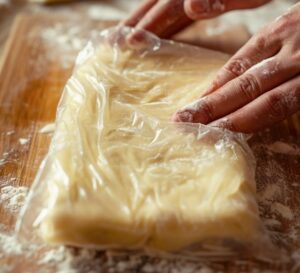
- Press the dough into a rectangle, wrap, and chill for 60 minutes in the fridge. Then divide into 10–12 pieces of 90–110 g. Roll each into a ball and keep them cold; take out one at a time while your counter is lightly dusted with flour.
- Preheat the oven to 200 °C (392 °F). Roll one portion of dough out on baking paper into a 22–24 cm round, about 2 mm thick. Dock with a fork 20–30 times and bake until evenly golden, 7–9 minutes, keeping an eye on the edges so they don’t get too dark.
- Repeat with the remaining portions: while one layer bakes for 7–9 minutes, roll the next one and keep it on a board in the fridge. Arrange the trimmings separately and dry them out at 190 °C (374 °F) for 8–10 minutes until crisp—these will become your crumb topping.
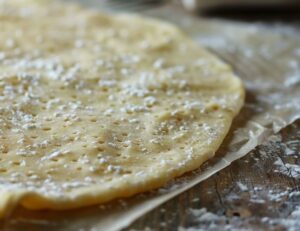
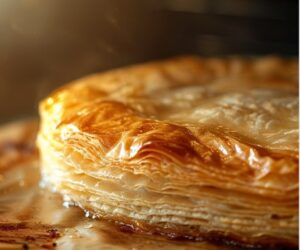
- For the custard, heat the milk until it’s just shy of boiling—look for steam and the first bubbles around the edge, about 85 °C (185 °F). In a separate bowl, whisk the yolks with the sugar and cornstarch until smooth and pale, about 2 minutes, with no dry lumps.
- Pour the hot milk into the yolk mixture in a thin stream, whisking constantly, then return everything to the saucepan. Cook over medium heat, whisking nonstop, until thick and you see big “blips” of bubbles, about 4–6 minutes. The custard should hold a distinct trail.
- Take the custard off the heat, add the vanilla, then beat in the soft butter in batches of 20–30 g until glossy. Cover the surface with cling film directly on the custard (to prevent a skin), cool to room temperature for 45–60 minutes, then chill for another 30 minutes to firm up.
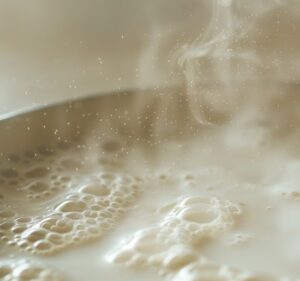
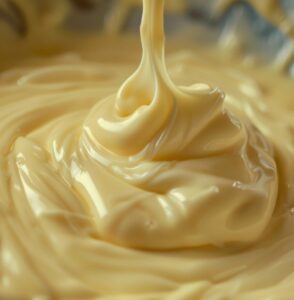
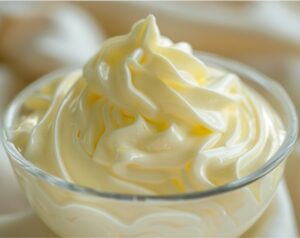
- Assemble on a flat serving plate: spread 2 tbsp custard on the base as “glue”, then add a pastry layer and 3–4 tbsp custard, smoothing it right to the edge with an offset spatula. Repeat, gently pressing with your palm every 2–3 layers; keep the top layer of custard a bit thinner so the crumbs sit neatly.
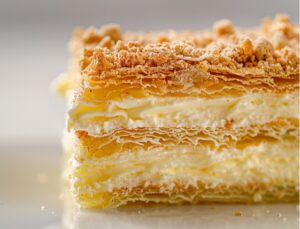
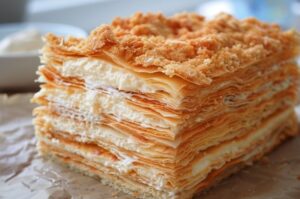
- Crush the dried trimmings into crumbs—some fine, some a bit chunkier for nicer texture. Cover the top and sides, then cover the cake and set a light weight (about 1–1.5 kg) on top for 30 minutes. Chill for at least 12 hours for the cleanest slices.
Notes
Private Notes
Tried this recipe?
Let us know how it was!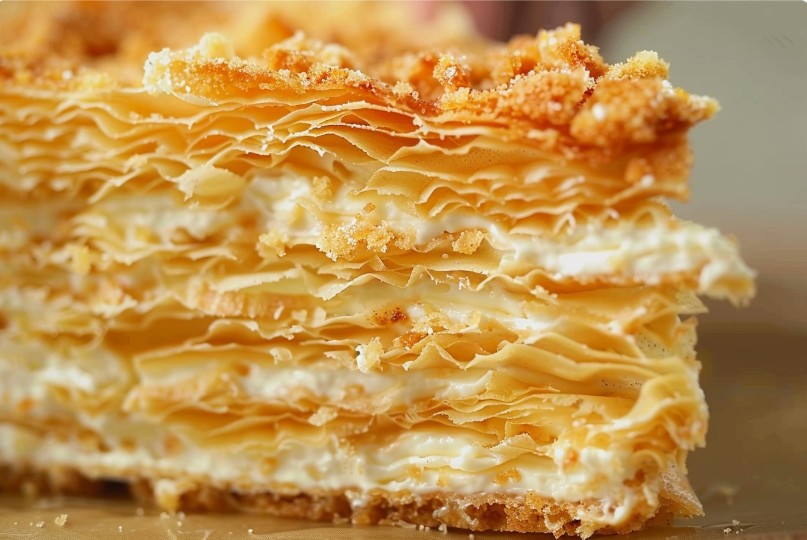
Nutritional notes for Napoleon cake
Milk brings protein and lactose, which also helps with browning during cooking. This cake is rich in energy from fats and carbohydrates, so it’s a proper dessert after dinner—no “health claims”, just a very good slice of cake.
- Energy for a busy day
- Protein from milk and eggs
- Fats help it feel satisfying
- Carbs support flavour and structure
Napoleon cake variations
Once, catering a big event, I grabbed the wrong box of nuts and mixed toasted hazelnuts into the crumbs. Honestly? Best “mistake” I’ve kept repeating. Now I’ve always got a couple of versions up my sleeve, depending on the mood.
- Custard with a little lemon zest
- A thin layer of raspberry jam between layers
- Crumb topping with toasted hazelnuts
- Custard made with half milk, half cream
- Decorate with caramelised flaked almonds
Questions & answers
Even perfectly baked layers taste a bit “off” if you skip the overnight rest.
How do I make the layers the same size?
Roll the dough on baking paper and cut a circle/rectangle using a 22–24 cm template; bake the trimmings separately for crumbs.
Why does Napoleon cake need to rest?
The custard slowly moistens the layers, making them tender and the flavour more even; ideally 12–18 hours in the fridge.
What if my custard turned out runny?
Put it back on medium heat and cook for another 3–5 minutes until thicker, or chill it and beat in 30–50 g soft butter to stabilise.
How long does the cake keep in the fridge?
In a container or under a cake dome—up to 3 days; the crumb topping softens, but the flavour stays rich.
Common mistakes when making Napoleon cake
Why didn’t it work? Usually it comes down to two things: temperature and moisture. Warm dough lets the butter melt out, and the layers stick together; warm custard softens the pastry unevenly. Keep the dough cold and let the custard cool completely, and suddenly the whole process becomes predictable.
Why are my layers hard instead of flaky?
The dough got too warm, or you worked in too much flour while rolling; chill it for 30 minutes and dust lightly.
Why did the layers puff up with big bubbles?
You didn’t dock the surface, or the oven was too hot; prick with a fork and bake at 200 °C (392 °F).
Why is my custard lumpy?
The eggs curdled from high heat; pour the hot milk in a thin stream and cook over medium heat, whisking constantly.
Why is the cake sliding and “floating” in layers?
The custard was still warm or too thin; cool it to room temperature and cook it down until it holds a clear whisk trail.






Responses