Fish Shakshuka: Which Types Work Best


There’s this moment in the kitchen: the pan already smells like tomatoes and spices, the sauce is quietly bubbling, you can practically hear the bread getting ready to crunch… and then your brain freezes: “Okay, but what fish? And when do I add it so it doesn’t turn rubbery?”
With fish shakshuka, the scary part usually isn’t the sauce or the eggs. It’s the fragility of it all. Chicken or sausage will forgive you: overcook it a bit, whatever. Fish won’t. It’s either tender and juicy, or it’s dry, smells sharp, and flakes into stringy bits.
That’s exactly why I love shakshuka with fish — it has this fine line you learn to walk. It teaches you to feel heat, timing, and aroma. And it gives you that satisfying sense of control: you’re not just tossing things into a pan, you’re steering the process so the fish stays fish — tender, clean-tasting, without that extra “ocean” hanging in the air.
Let’s break down which fish works best, why some types melt into the sauce like butter while others make the whole dish feel harsh, and what to do if you’ve already bought “the wrong one” or something went sideways while cooking.
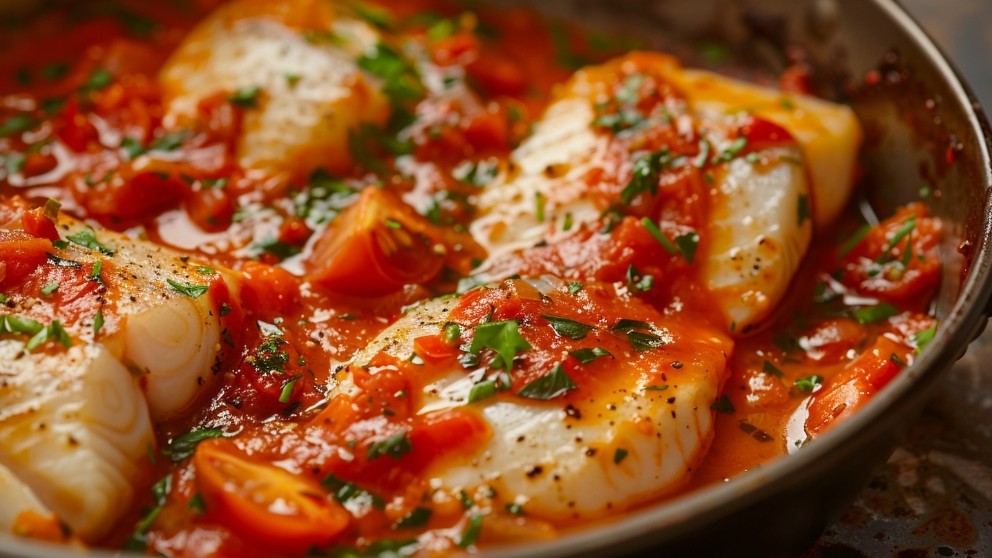
What fish is doing in shakshuka — and why it’s not just an add-on
Shakshuka isn’t soup and it isn’t stew. It’s a sauce that holds its shape but stays juicy, with pockets of softness (the eggs) and a bit of structure (veg, spices, bread on the side). Fish has a third job here: bring protein tenderness without heaviness.
In real life, that means two things.
First: the fish shouldn’t need a long cook. The sauce can happily bubble for 30 minutes — it often gets better. Most fish doesn’t need anywhere near that. If you simmer fish in the sauce for too long, it dries out, and its fat (if it has any) can throw off that “fishy” note not everyone wants.
Second: the fish has to play nicely with tomato acidity. Tomatoes are loud. They highlight everything: sweetness, spices, and… the tiniest hint of not-so-fresh. So in fish shakshuka, freshness isn’t foodie fussiness — it’s the foundation of the flavor.
When it all clicks, the pan looks exactly how you want it to: the sauce is thick and smells like tomatoes and peppers, the fish holds together but yields easily to a fork, and the aroma stays clean — no “aquarium” vibes. I love that moment when you nudge a piece with a spatula and it springs back a little, but doesn’t fight you.
A tiny story from my kitchen: “I meant well… and then reality happened”
Once I decided to “boost” the flavor and added the fish almost at the start, right along with the tomatoes. I figured it would soak everything up and taste deeper. What I got instead: a gorgeous sauce and fish as dry as something reheated in the microwave. The most annoying part? It wasn’t bad fish. I just gave it an extra 8–10 minutes of boiling, and protein did what protein does: tightened up, squeezed out the moisture, and that was that.
Since then, the rule is simple: in shakshuka, fish almost always goes in at the end. There are exceptions, but they’re rare.
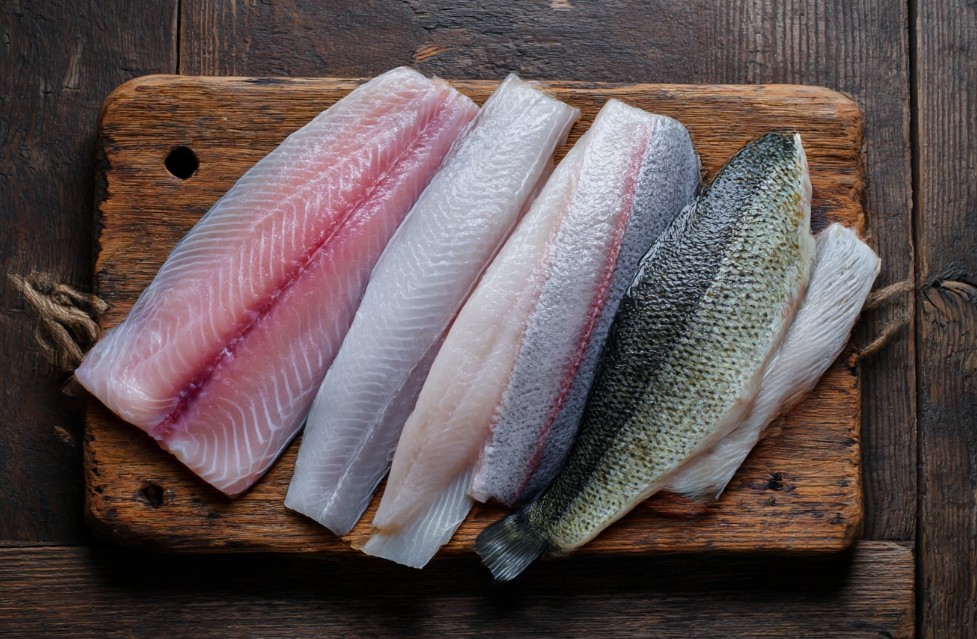
How to choose fish: what to look at, smell, and feel with your fingers
I’m not a fan of “just buy the freshest fish” because it’s basically an order with no instructions. Let’s make it practical: what exactly to check when you’re standing at the counter or opening a pack at home.
Smell. Fresh fish smells like water, the sea, sometimes even cucumber (some white fish do). It shouldn’t have that sharp “fish” trail that hits you in the face. If you can smell it before you even bring it close, that’s your cue to be cautious. In shakshuka, tomatoes and spices won’t hide it — they’ll spotlight it.
Texture. Press the fillet with a finger: it should feel springy and bounce back. If an indent stays, the fish is either not at its best or it’s been through the freeze/thaw cycle more than once.
Moisture. Extra liquid in the pack is common. But if the fish is basically swimming in cloudy juice and the surface feels slimy, I wouldn’t choose it for shakshuka. This dish really depends on clean flavor.
Color. White fish should look even, without yellowing around the edges (often a sign of fat oxidation). Salmonids should be free of faded patches and dark, dried-out edges.
Quick tip: if store-bought fish smells “too fishy,” sometimes 10–15 minutes in very cold water with a pinch of salt helps, then pat it really dry. It’s not magic, but it can remove surface odor. If the smell is deep in the flesh, you won’t wash it out.
Fresh or frozen: which is better for fish shakshuka
Fresh is ideal if you trust the source. But good-quality frozen fish works too — you just have to handle it more carefully.
The issue with frozen fish in shakshuka isn’t “worse taste,” it’s water. After thawing, it often releases a lot of liquid. And shakshuka sauce should be thick enough to hug the eggs and fish, not turn into tomato punch.
So the rule is simple: thaw slowly (in the fridge), pat dry, and only then add it to the sauce. If you toss in a half-frozen piece, it cools down that area of the pan, the sauce stops simmering properly, and the fish starts dumping water even faster.
The best fish for shakshuka: from delicate to ‘holds up to heat’
I like to sort fish for shakshuka not by “cheap/expensive,” but by how it behaves in hot sauce. What matters is whether it holds its shape, how fast it cooks, and what its fat does in tomatoes.
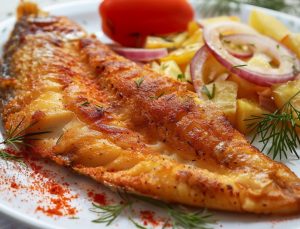
Delicate white fish (cod, hake, pollock, haddock)
This is the easiest entry point into fish shakshuka. White fish has a clean flavor and gets along with tomatoes beautifully. But it’s also the most vulnerable: overcook it and it turns dry.
Pros: mild aroma, tender flakes, usually easy to find.
Cons: falls apart easily, especially if you stir; doesn’t like long simmering.
When I use cod or hake, my mindset is: “It needs time to warm through and finish cooking, but not enough time to panic.” In other words: short contact with hot sauce, no aggressive boiling.
Fattier fish (salmon, trout)
Salmonids bring a luxurious tenderness and that buttery feel. In shakshuka it can be gorgeous: the sauce turns velvety and the fish pieces feel almost pillowy.
But there’s a catch: fat combined with tomatoes and spices can amplify aroma. If the fish isn’t truly fresh, you’ll notice immediately. Also, salmon is easy to push into dry flakes if you keep it at a hard simmer.
Quick tip: with salmon, I like bigger chunks and a very gentle simmer — almost like it’s steaming in the sauce. It stays juicy and doesn’t crumble.
Firm fish that holds its shape (fresh tuna, swordfish where available)
This is for people who like fish with a bit of bite. It doesn’t fall apart, doesn’t turn into crumbs, and it’s harder to accidentally destroy with heat.
But there’s a different trap: firm fish can end up a little dry if you cook it all the way through in the sauce. For a home kitchen, I’d either watch it like a hawk or pick a more forgiving type.
Sardines, mackerel, herring: when to skip and when to go for it
These are “personality” fish. Delicious, but with a bold aroma and fat that can get loud in tomatoes. If you love a strong sea-forward profile, go for it. If you’re after something delicate, don’t start here.
There’s also a practical point: mackerel and herring are often sold smoked or salted. That’s a different story — they can bulldoze the sauce.
I’ll sometimes use sardines as an accent, but then I build the whole flavor around them. If the goal is a gentle fish shakshuka, I’d save these for other dishes.
Seafood as a “fish” alternative
Shrimp, squid, mussels — not fish, but people often go this route when they’re worried about drying out fillets. And the logic is there: shrimp cook fast and bring a sweet, seaside aroma.
Still, the margin is even thinner. Squid turns rubbery with a couple extra minutes; shrimp goes dry. If you’re using seafood, keep this in mind: it’s a finishing touch, not something you simmer along with the sauce.
The tenderness mechanics: why fish dries out and how to stop it
This is where the “magic” starts — and it’s actually very down-to-earth.
Fish is mostly protein and water, with relatively little connective tissue (especially in delicate white fish). As temperature rises, proteins coagulate and tighten. Tighten up — they push out water. If that process is intense or prolonged, moisture leaves and the flesh turns firm and dry.
In shakshuka, two things nudge you toward overcooking:
- boiling (especially an aggressive simmer with big bubbles);
- tomato acidity, which also affects protein structure.
Acid doesn’t “ruin” fish, but it can make proteins more sensitive. So in tomato sauce, fish can seize up faster than you expect.
So what do you do on a home stove?
Three dials you actually control
- Piece size. Bigger chunks forgive more because there’s a juicier center. Small cubes dry out instantly.
- Sauce temperature. A gentle simmer is your friend. High heat is the enemy of tenderness.
- Contact time. Fish should finish cooking, not boil. Often it’s just a few minutes.
Quick tip: if you’re nervous about timing, turn off the heat and let the fish finish in residual heat under a lid. The sauce is hot, the pan holds temperature — the fish cooks gently, without boiling.
Tiny story: how I “saved” overcooked cod
Once I got distracted by a phone call and left cod in the sauce longer than I should have. It turned firm. I didn’t toss it: I took the pan off the heat, added a little warm water (literally a few spoonfuls), covered it, and let it sit. The fish didn’t become perfect, but some juiciness came back thanks to steam and a gentler environment. Not a miracle — just better than “sand” in your mouth.
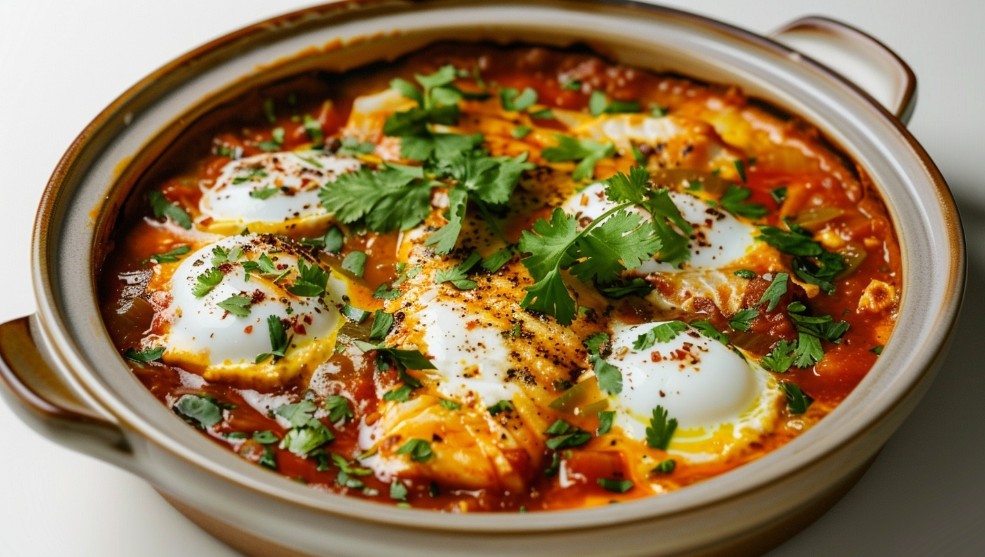
The smell mechanics: where that ‘fishy’ aroma comes from and how to keep it clean
Smell is what scares people most about fish shakshuka. And I get it: you want your kitchen to smell like tomatoes, peppers, garlic — not the supermarket seafood aisle.
Most of the time, that sharp aroma isn’t from spices or tomatoes, but from a combo of three things:
- less-than-ideal freshness (even slightly);
- oxidized fat (especially in fatty fish or fish that’s been sitting around);
- overheating — when fat and protein get pushed too hard in an aggressive environment.
Tomato sauce acts like an amplifier: it highlights the good and the bad. If the fish is fresh, you’ll get a pleasant, light sea note. If it isn’t, it turns harsh.
How to keep the aroma delicate
- Pat the fish dry. Moisture on the surface = more “boiling,” more aroma compounds escaping into steam.
- Don’t simmer the fish for long. The longer it cooks, the more aroma moves into the sauce and the air.
- Add fish to a sauce that’s already balanced. When the sauce is reduced and smells like itself, the fish blends in more gently.
- Don’t go hard on garlic at the start. Burnt garlic + fish = harshness. Keep it gentler, or add part of it closer to the end.
Quick tip: for the cleanest aroma, warm the fish in the sauce under a lid on the lowest heat. The lid traps steam, the fish finishes gently, and the smell doesn’t flood the kitchen.
What the right process looks like on a home stove: timing, heat, doneness cues
I’m not giving a full recipe here, but I’ll give you something more useful: cues. Stoves vary, pans vary, fish varies. Cues are what stay reliable.
At home it often goes like this: the sauce hasn’t reduced yet, you’re impatient, you add the fish so you “don’t waste time,” and the fish ends up sitting in a thin, boiling liquid for ages. That’s the fastest route to dryness and a strong smell.
When to add the fish
I go by sauce consistency: it should be thick, with small, lazy bubbles. When you drag a spatula across the bottom, you should see a trail for a second or two — it shouldn’t fill in instantly. That’s when the fish won’t “boil in water,” but will finish gently in a thicker sauce.
Signs the fish is done (without a thermometer)
- The color turns even. Any translucent or darker raw patches disappear.
- The piece springs back. Press lightly — it’s resilient, but not rubbery.
- Fork flaking. Slide in a fork and the flesh separates into big, juicy flakes, not dusty crumbs.
- The smell turns warm and slightly sweet. Not sharp. Good fish has a pleasant aromatic “sweetness” when heated.
If the fish is already breaking into thin strands from the lightest touch, you’re right at the edge. For shakshuka, it’s better to stop a little earlier and let it finish under a lid.
Tiny story: “the pan is hot, the fish is cold”
One of the most common home scenarios: fish goes straight from the fridge into hot sauce. The outside seizes up while the center is still cold, you get nervous and keep cooking. Result: dry outside, finally-cooked inside — but too late.
A simple habit helps me a lot: let the fish sit for 10 minutes at room temperature (not an hour — just enough to take off the icy shock), then pat it dry. The difference is real: it cooks more evenly.
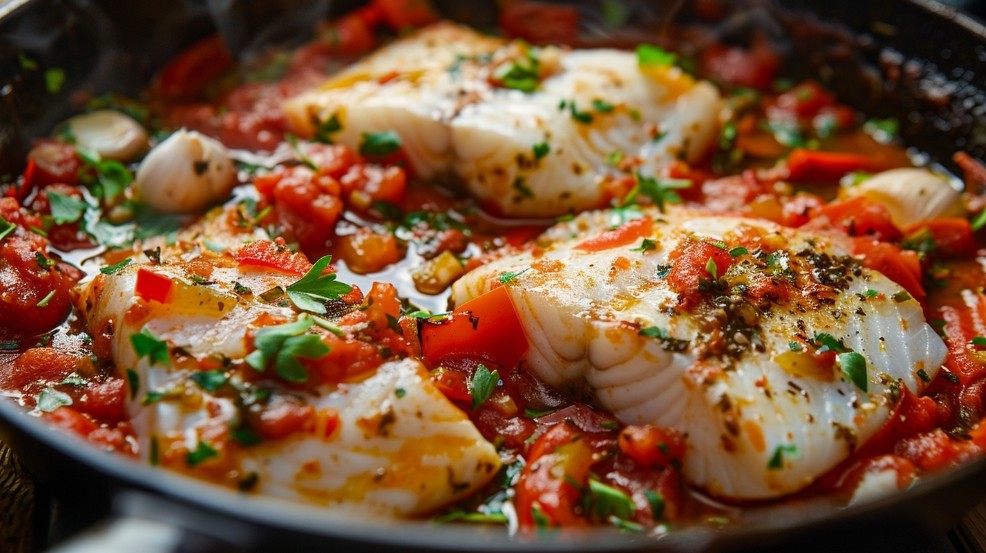
Common beginner mistakes: what people do vs what works better
Here’s what I see most often — and yes, I’ve done all of this on my own stove at some point.
Mistake 1: cutting the fish small “so it cooks faster”
What people do: dice it into tiny cubes, toss it in, stir — and a few minutes later they’ve got fish crumbs in sauce.
What works better: keep bigger chunks. They hold together, look appetizing, and you can judge doneness by the piece — not by “puree.”
Mistake 2: adding the fish too early
What people do: the sauce is still thin, but they want “everything together.” The fish ends up simmering forever.
What works better: reduce the sauce to the right thickness and aroma first, then add the fish for a short finish.
Mistake 3: high heat “to make it quick”
What people do: everything boils and splatters, the sauce reduces unevenly, and the fish dries out on the outside.
What works better: a gentle simmer. Shakshuka loves calm heat — it comes out more cohesive and tender.
Mistake 4: trying to “cover the smell” with spices
What people do: if they’re unsure about the fish, they add more garlic, pepper, chili. The result is an even sharper, heavier smell.
What works better: don’t fight flavor with brute force. If the fish is questionable, it’s better to switch the ingredient or cook something else. For delicacy, do the opposite: keep spices balanced and don’t burn the aromatics.
Mistake 5: stirring after the fish is already in
What people do: stir “to distribute evenly.” And they break the pieces.
What works better: once the fish goes in, move it as little as possible. Spoon sauce over the top instead of stirring.
Quick tip: if you want the fish to soak up the sauce, don’t stir — just scoop up sauce with a spoon and baste the fish a few times. Same effect, intact texture.
What to do if something goes wrong: the fish fell apart, smells strong, or turned out dry
Kitchen mishaps happen even when you’re careful. The key is not to panic and not to toss everything immediately. There are a few realistic ways to nudge things back on track.
If the fish fell into small pieces
Not the end of the world. The dish will just be closer to a thick tomato sauce with fish flakes.
- Stop stirring. Let everything settle.
- Make the texture more “controlled.” Let the sauce reduce a bit on the lowest heat so the flakes aren’t floating in liquid.
- Presentation helps. With an egg on top (or anything creamy), the smaller fish reads like a choice.
If a sharp smell appears
First, be honest with yourself: is it the fish itself, or is it overheating/burnt garlic?
- Lower the heat or turn it off. The first move is to stop whatever is intensifying the smell.
- Cover and let it sit for 5 minutes. Often the aroma “gathers” and softens.
- A touch of sweetness or acidity — carefully. If the sauce tastes too sharp, a pinch of sugar or a bit of sweet pepper in the sauce (if it’s already part of your base) can help. But if the problem is freshness, it won’t hide it.
I’m not a fan of “just add lemon” in these situations. Lemon can make the aroma even more piercing and underline the fishiness. If you do add it, keep it minimal — and only if you’re sure the fish is fine and the smell just got too intense from heat.
If the fish turned out dry
- Take it off the heat. It will only get worse.
- Add a little warm moisture. A few spoonfuls of hot water or extra sauce (if you have some) plus 3–5 minutes under a lid can soften the texture.
- Don’t over-salt. Salt highlights dryness. It’s better to adjust the sauce, not the fish.
Quick tip: if you can tell the fish is almost done but you’re worried about a raw center, turn off the heat and cover the pan. Residual heat is gentler than two more minutes of boiling.
Small choices, big payoff: 7 practical details
None of these look like “chef secrets,” but they genuinely make fish shakshuka calmer to cook — and better to eat.
- Choose a wider pan, not a deeper one. It’s easier to control the simmer, and the fish can sit in a single layer.
- Pat the fish dry and salt it 5–10 minutes before adding. Not an hour. A little time is enough for the surface to feel more “set.”
- Place the fish in the calmest zone. If one side of the pan bubbles harder and the other is quieter, the fish belongs in the quieter spot.
- Don’t cover on high heat. Under a lid, everything boils more aggressively. A lid works when the heat is minimal.
- Leave space between pieces. When fish is packed tightly, it steams more and falls apart more easily when you move anything.
- Listen to the sound. This helps me a lot: the right setting is a soft “puff-puff.” If you hear aggressive sizzling and splattering, the heat is too high.
- Remember carryover heat. Even with the burner off, the pan keeps cooking for a few minutes. Plan for that, especially with white fish.
Fish shakshuka isn’t about complexity. It’s about attention. Once or twice you catch the right moment to add the fish and you learn how the sauce should sound and smell at a gentle simmer, the fear of “ruining it” disappears. In its place you get a really nice feeling: you’re in charge of the tenderness.
I’m curious: do you prefer white fish in shakshuka for that clean flavor, or salmon for something richer and velvety? And what’s the trickiest part for you — choosing fish, dealing with smell, or nailing the doneness?