How to Make Perfect Pancakes

For many, pancakes are something homey, warm, like a piece of childhood that can be quickly brought back to the kitchen. But once you start, suddenly everything goes wrong: the batter tears, pancakes stick, and instead of a golden crust, you get pale ‘rubbery’ circles. I’ve met people who are afraid to make pancakes on their own — it seems like some special magic available only to the ‘talented.’ But that’s not the case. Most mistakes are not about inability but about misunderstanding the process. I was once afraid to flip the first pancake myself…
The feeling of control in the kitchen comes when you understand why you do things a certain way and not another. Pancakes are a great exercise for this: they are simple but open the door to a deeper understanding of food. You don’t need to be a chef to cook them boldly. A little practice, a little observation — and you’re no longer afraid of the ‘first pancake lump’ or too many holes in the batter. I’ll show you how it works, not from an instructional point of view, but through feelings, mistakes, and small discoveries.
Why Pancakes Sometimes Fail: Understanding the Fears
Being afraid of ruining pancakes is normal. Most fears come from experience: someone once flipped a pancake, it tore — and then you lose confidence. I remember how my mom used to joke when I was a child: ‘The first pancake is like a lottery, it gets easier after that.’ But when you understand, most problems have simple causes.
- Pancakes stick to the pan — often due to a pan that’s not hot enough or not properly greased.
- Tear when flipping — usually due to batter that’s too thin or ‘overworked.’
- Come out ‘rubbery’ — a result of either overmixing or too much flour.
- Not cooked inside — either too thick a layer of batter or too low a stove temperature.
Fear is not an enemy but a hint: if something didn’t work out, it’s not the end of the world. It’s a voice saying, ‘Try differently.’ When you understand why a pancake stuck or tore, it’s no longer scary. I still sometimes catch myself making small mistakes — and each time it’s a new experience, not a failure.
How Pancake Batter Works: The Mechanics You Feel with Your Hands
Pancakes are simple chemistry: flour, liquid, eggs, a bit of fat. But the main thing is not the list of ingredients, but how they interact.
Binding: What the Egg Does
The egg is not just ‘for color.’ It binds the batter, gives elasticity, and holds the shape. If there are too few eggs in the batter, the pancake will tear; if too many, it will become too dense, almost ‘omelet-like.’
Flour: Tackiness and Measure
Flour is the base. Its main property is stickiness. As soon as you mix it with liquid, gluten begins to form. If you mix for too long, the batter becomes sticky, the pancake ‘rubbery.’ If there’s too little flour, pancakes tear; if too much, they’re thick and heavy.
I always focus on the consistency: the batter should be like light cream, flowing in a ribbon but not watery. It’s much easier to add flour drop by drop than to dilute batter that’s too thick.
Liquid: Milk, Water, Kefir?
The choice of liquid affects the structure. Milk gives softness and a light sweetness, water gives a crispy crust, kefir gives fluffiness and a slight tang. In practice, I often mix milk with water: this way, pancakes have both tenderness and a bit of crunch at the edges.
Tip: If you’re unsure which liquid to choose, try making half the batch with milk and half with water. Compare the taste and feel.
Fat: Why It’s Here
Fat (oil, butter) is needed not only for the pan but also in the batter itself. It gives pancakes softness, prevents sticking, makes the edges crispier. You can feel the difference, especially after the first bite: a pancake with oil will be elastic, with butter — aromatic and tender.
Pan Temperature: How Not to ‘Burn’ or ‘Boil’
The pan is the heart of pancakes. Its temperature affects everything: from color to structure. The main thing here is not to rush.
How to Know the Pan is Ready
There’s a simple test: drop a bit of batter on the pan. If it starts to sizzle and quickly sets, the temperature is right. If the batter ‘spreads’ and doesn’t change color, it’s too early. If it smokes, it’s too hot, better to lower the heat a bit.
I like to use an old heavy pan that’s about 15 years old. It holds temperature well, and pancakes come out evenly. But any pan will do — the main thing is that it doesn’t stick. Before the first pancake, I always grease the bottom with a bit of oil.
First Try: Don’t Be Afraid to Experiment
The first pancake is a test. It will show if everything is okay with the temperature and batter thickness. Often the first pancake is ‘sacrificed’ for a trial, and that’s normal. After it, you feel the rhythm: how much batter to pour, how quickly to flip.
Tip: If the first pancake didn’t turn out, don’t worry. Try adjusting the temperature: increase or decrease the heat by one notch.
Thickness and Thinness: How to Adjust and Why It Matters
Thinness is not just about appearance. The thickness affects how the pancake cooks, whether it will be tender or ‘rubbery.’ Sometimes people pour too much batter because they’re afraid of holes or think ‘thicker is more filling.’ In fact, a thin pancake cooks quickly and doesn’t dry out inside.
How to Pour and Spread the Batter
I always pour the batter with a ladle in the center of the pan and quickly rotate it so the batter spreads in a thin layer. It takes just a few seconds. If the batter doesn’t spread, it’s too thick, better to add a bit of liquid.
Everyone has their favorite thickness. I like it when the pancake is almost transparent but doesn’t tear. If you want it a bit thicker, that’s fine, as long as it cooks evenly. Test by touch: if the edges easily come away from the pan, the pancake is ready to flip.
Common Mistakes with Thickness
- Poured too much batter — the pancake takes a long time to cook, raw inside.
- Batter is thick — the pancake turns out like a fritter, not a pancake.
- Nervous and try to spread the batter with a spoon — this makes the surface uneven, the pancake tears.
How and When to Flip Pancakes: Feelings and Signs
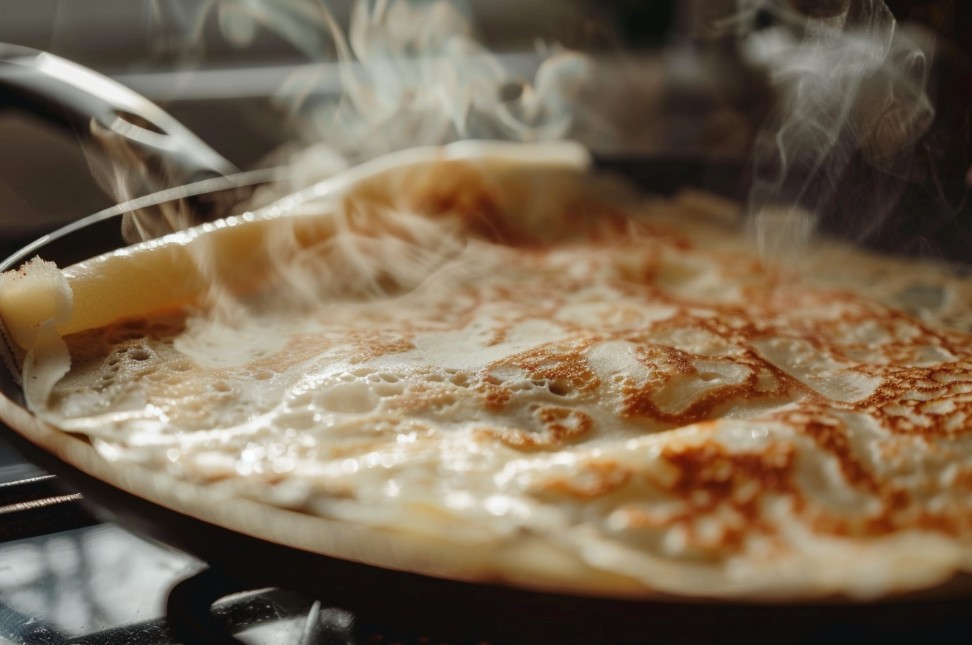
The moment of flipping is what scares many. Pancakes can stick, tear, curl up. I always wait until the edges start to dry and easily come away from the pan. Then I lift with a spatula, gently ‘rock’ the pancake — and only then flip.
Visual and Tactile Signals
- Edges become drier and slightly lighter.
- The batter on top doesn’t flow.
- Under the spatula, the pancake easily comes away from the pan.
Sometimes a pancake sticks on one side. Then gently lift it with a spatula, help with your fingers if needed (just don’t burn yourself!). I’ve saved many this way, even if the pancake tore a bit — it’s still delicious.
Golden Crust and Aroma: What Affects Appearance and Smell
Pancakes entice not only with taste but also with smell, appearance, a light crunch at the edges. This is the result of a reaction that occurs on a hot surface.
Maillard Reaction: Where Does the Smell Come From
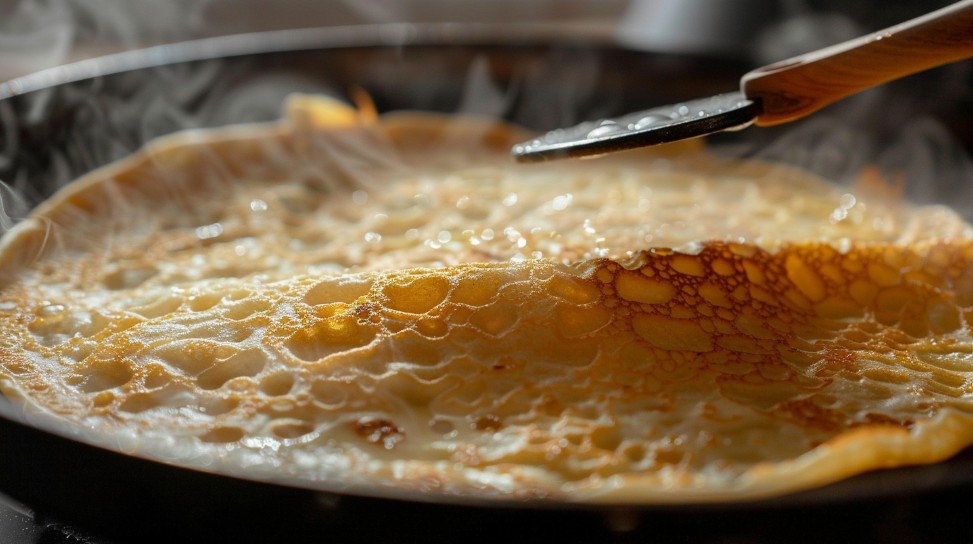
When a pancake touches the pan, the proteins and sugar in the batter begin to ‘caramelize.’ This is what creates the golden crust, characteristic aroma, and a slight taste of browned butter. If the temperature is low, the pancake will be pale; if high, it may burn before cooking through.
I always rely on smell: when a light baking aroma appears in the room, it’s a signal that the pancake is almost ready. If the smell is sharp, smoky — the heat is too strong.
Color and Texture
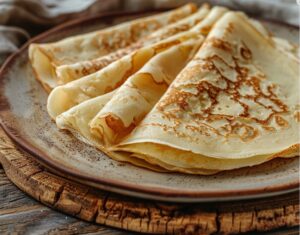
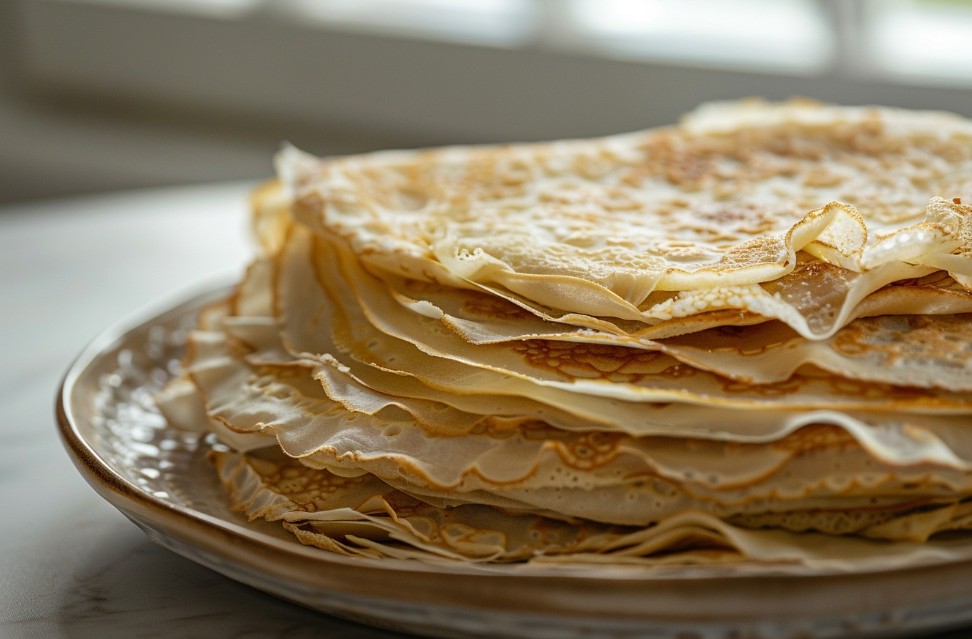
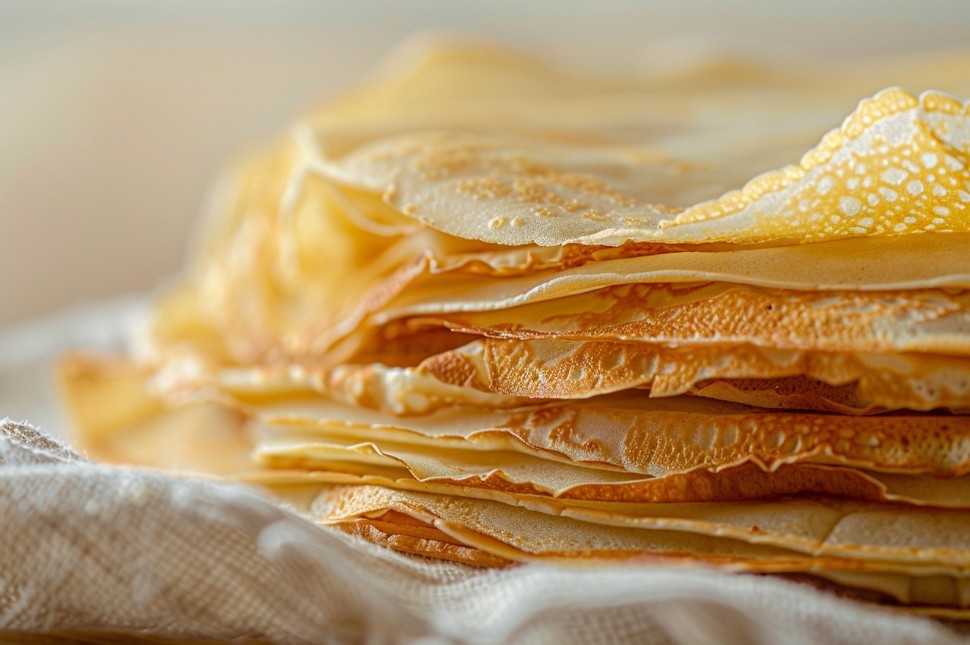
An ideal pancake is light golden, with small porous holes, thin but strong. At the edges — a light crunch. If you want a richer color, add a bit of sugar to the batter — but don’t overdo it, or the pancakes will burn quickly.
What to Do If Something Goes Wrong?
No batch of pancakes is perfect the first time. Pancakes are about practice and observation, not ‘talent.’ Here are some common situations and working solutions.
Pancakes Tear or Stick?
- Check the pan: if it’s new, it’s better to ‘season’ it a bit before frying, greasing with oil or a piece of lard.
- Add a bit of flour and mix — maybe the batter is too thin.
- If only the first pancake sticks — that’s normal, it should get easier after that.
Pancakes Are Thick and Raw Inside?
- Try pouring less batter, making a thinner layer.
- Increase the pan temperature, but don’t make it ‘dragon-like.’
Pancakes Are ‘Rubbery,’ Not Tender?
- Mix the batter less — just enough to remove lumps.
- Add a bit of oil directly to the batter.
- Let the batter sit for 10–15 minutes before frying.
Micro Story
Once, I was making pancakes on a country stove — an old pan, sharp heat, batter ‘by eye.’ The first three pancakes stuck so much that I barely got them off. Then I lowered the temperature, added a bit of oil to the batter — and everything went smoothly. I still remember that moment: it wasn’t technique, but ‘intuition’ that saved the situation.
Life Hacks for Perfect Pancakes: What Works in Practice
- Add batter to the pan on a hot surface — the pancake won’t have time to stick.
- Grease the pan with a thin layer of fat, don’t overdo it — excess oil makes the edges tough.
- Let the batter rest for 10–20 minutes before frying — this relaxes the gluten, and pancakes won’t tear.
- If pancakes come out dry — try adding a spoonful of sour cream or butter to the batter.
- For an even crust, periodically wipe the pan with a paper towel, removing excess fat and remnants of the previous pancake.
Tip: If you’re afraid to flip the pancake in the air, use a wide spatula — it’s no less an art than ‘acrobatics.’
Pancakes as an Exercise in Mindfulness and Freedom
Pancakes are not just about food, but about feeling the moment. When you stand by the stove, watch the color, listen to the sizzle, smell the aroma — it’s a true culinary meditation. Pancakes should be made not ‘for the sake of it,’ but for yourself, for the feeling of the process. With each time, you understand your pan, your batter, your movements.
I love making pancakes on Sunday mornings when everyone is still asleep. Silence, the smell of batter, the first whisper of butter on the pan — like a little holiday. Over time, you realize: there is no perfect pancake, but each next one is better than the last. And the fear disappears because experience and confidence appear.
Common Mistakes and How to Avoid Them
- Too thin or thick batter — adjust the consistency gradually, adding liquid or flour by the spoonful.
- Mixing ‘to perfection’ — a few strokes are enough, no need to fight lumps to the end.
- Pan not hot enough — always preheat it in advance.
- Excess oil — pancakes come out greasy and heavy, especially in the first batch.
- Sticky edges — wait until the edges dry, don’t rush to flip.
Over time, each mistake becomes a small discovery. I still sometimes ‘catch’ new nuances, even though I’ve been making pancakes for many years.
Your Pancakes: A Space for Experiments
When fear disappears, curiosity arises. Pancakes are a canvas for experiments: you can change the liquid, add herbs, zest, try different oils. But it all starts with understanding the basics. When you feel the batter, know your pan — then anything is possible. I often try new combinations — and it doesn’t always work the first time, but that’s what’s most interesting.
Pancakes are about freedom. Don’t be afraid to try, make mistakes, pour batter on the pan again. With each pancake, you become more confident, and fear gives way to curiosity. And someday, there will be a moment when you say: ‘This is my perfect pancake.’
In the end, pancakes are not about magic, but about mindfulness, observation, and the small joy of the process. What associations do pancakes evoke for you? Do you have any tricks that helped overcome fear in the kitchen? Share in the comments — it’s always interesting to learn other people’s kitchen stories.