How to Organize Your Kitchen When You Have Kids at Home

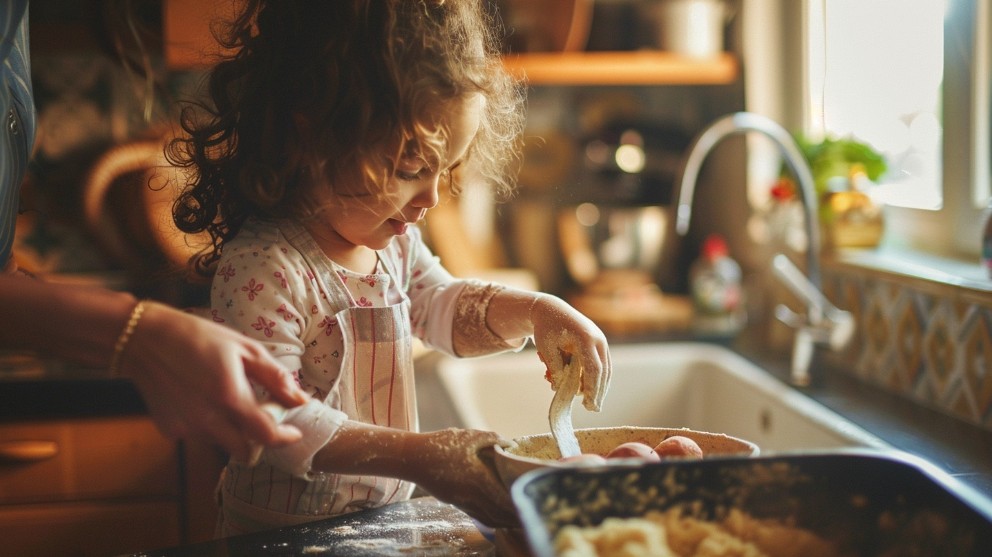
It always happens the same way: you’ve just put the kettle on, you’ve barely set a cutting board on the counter, and then—tiny bare feet in the doorway. Someone drags over a chair, someone asks, “Can I stir?”, and someone has already found a spoon in a drawer and is drumming on a pot like it’s a concert. In about five seconds, the kitchen stops being “yours” and becomes shared territory. And honestly, that can be scary—not the kids. Us.
Because the kitchen is sharp, hot, and slippery. Water ends up on the floor, a knife can slide off the edge, a pan handle sticks out into the walkway, and the oven clicks like it’s warning you: “don’t even think about it.” When a child is nearby, a parent’s brain often flips into full control mode: “Don’t touch.” “Move back.” “I’ll do it.” And then cooking together ends faster than the water can boil.
I like a different approach: set the kitchen up so attentiveness feels natural, and safety is quiet—no drama. Not a sterile bunker, but a space where your kid can be close, do something with their hands, and you’re not running on adrenaline. It’s all the small decisions: what lives where, how things are placed, and which rules sound calm enough to actually stick.
I’ve seen it so many times: one drawer moved to a new spot takes away half the tension. A small mat by the sink prevents slips. A separate “kid” set of tools cuts down on chaos and gives them that proud “I’m helping” feeling. That’s what we’re doing here—simple, practical, real-life stuff.
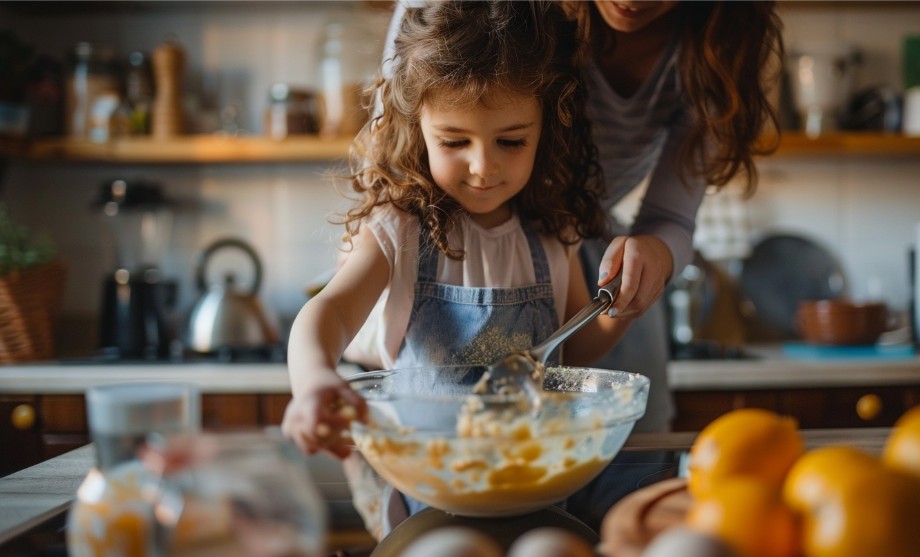
The kitchen through a child’s eyes: what’s “fun” and what’s “dangerous”
An adult sees the kitchen as a route: grab, chop, set, wash. A child sees an amusement park. Shiny handles, doors that open, buttons that click, running water, flour that pours. And then there are the smells. Sweet pulls you in, hot feels exciting, and whatever is sizzling is basically begging to be checked with a finger.
When I’m helping a family set up a kid-friendly kitchen, I start with one simple exercise: I “walk” through the kitchen at a child’s eye level. Not necessarily on my knees (though sometimes, yes), but mentally—what will be the first “I want”? Usually it’s:
- lower drawers—because they’re easy to open;
- the cabinet under the sink—because it feels like a secret room;
- the oven handle—because it’s the perfect thing to grab;
- the edge of the countertop—because you can pull yourself up and peek;
- anything that clinks, rings, or bangs.
Here’s the key shift: don’t aim for a world where your child never touches “the wrong thing.” That’s almost impossible. Aim for a kitchen where the “wrong thing” is either out of reach or not a big deal—and the “right thing” is easy to access and genuinely interesting.
A quick kitchen story: at one workshop, a mom came with her five-year-old. She kept catching his hands—“Don’t touch the knife! Don’t open that! Don’t climb!” And he was like a spring: the more “no,” the faster the hands. We simply gave him his own drawer with a plastic bowl, a whisk, a silicone spatula, and two measuring spoons. Ten minutes later he was “running the show” over there, and his mom finally exhaled. The kitchen didn’t become magically safe—it became understandable.
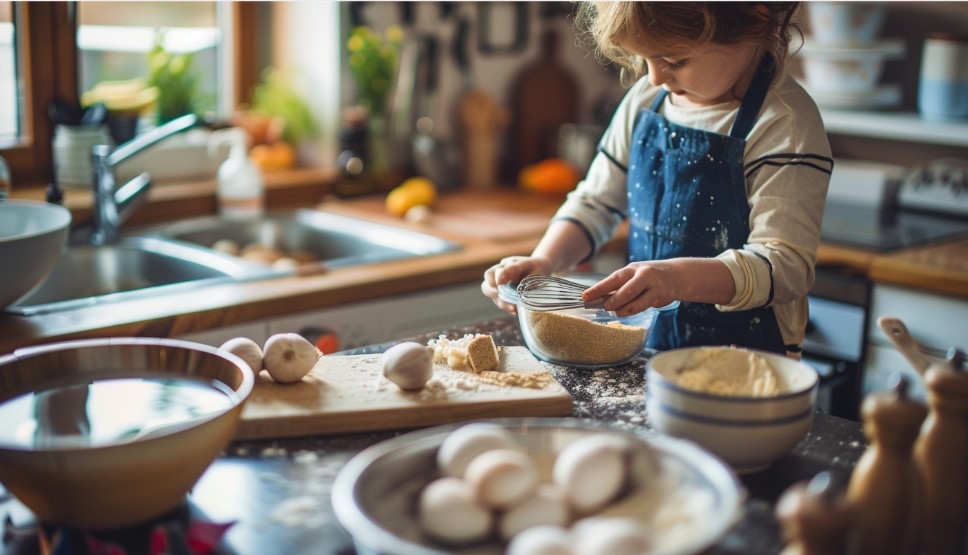
Kitchen zones: how to set up the space so you’re not constantly saying “don’t”
It helps to think of the kitchen as three zones: hot, sharp, and calm. The goal is to make it easy for your child to drift toward the calm zone—without accidentally ending up in the hot one.
The hot zone
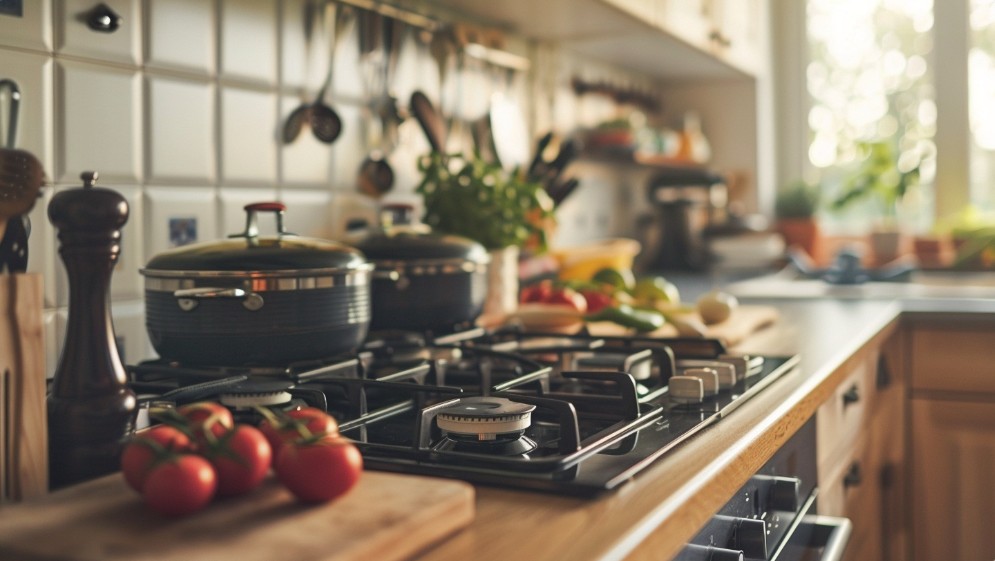
Stovetop, oven, boiling water, frying pan, steamer, air fryer—anything that can burn you even “for a second.” Here, it’s less about bans and more about physical habits:
- turn pot and pan handles inward, not into the walkway;
- keep the kettle closer to the wall; keep the cord short and loop-free;
- don’t park lids on the edge of the counter (they’re too easy to swipe off);
- if a little one is nearby, don’t carry a hot pot “over their head”—walk around, or ask them to step back one pace.
Tip: assume your child can appear silently right behind you. You’ll automatically stop making sudden moves with hot things.
The sharp zone
Knives, graters, can openers, skewers, even some peelers. One rule does most of the work: sharp things don’t live down low. If knives are in a knee-level drawer, it’s a matter of time—not discipline.
I like either a magnetic strip placed high up, or a knife block on the counter—but positioned so a child can’t reach it even if they climb onto a chair. And the grater? It often feels “not that dangerous,” but grater scrapes are miserable. I keep mine either in an upper cabinet or in a lidded container so there’s no temptation to “see what it feels like.”
The calm zone
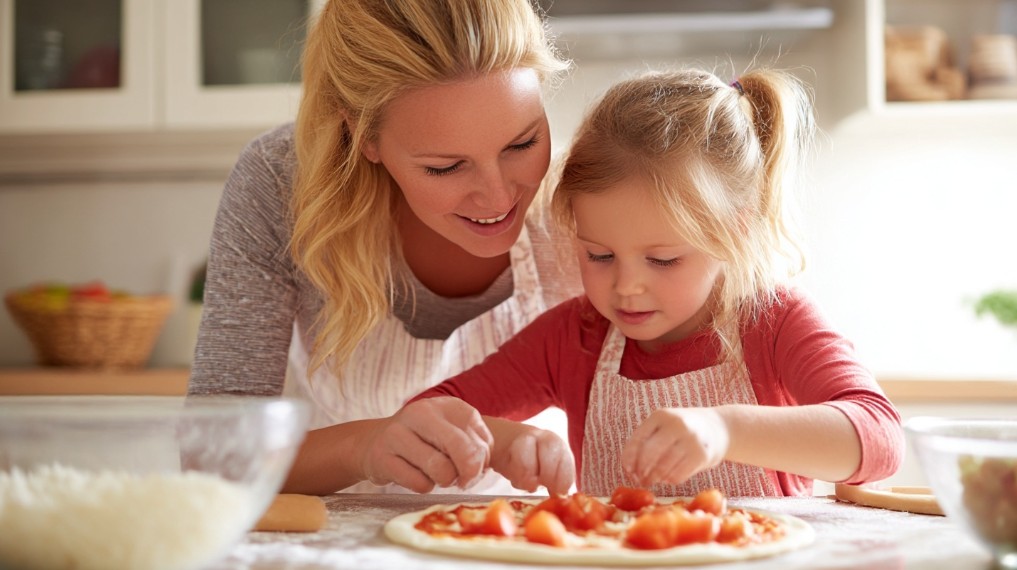
This is the heart of cooking together. A place where your child can do something real: wash an apple, stir, pour, fold napkins, weigh ingredients, knead dough with their hands (and yes, there will be flour up their nose—welcome to childhood).
The calm zone doesn’t have to be a separate table. Sometimes it’s just a corner of the counter you “give” to your child by clearing away anything hot or sharp. I love putting down a tray or a large board there—it creates a boundary. Kids find it easier to keep “their” mess contained, and cleanup is faster: lift the tray and you’re done.
Tip: a tray in the calm zone is like a tiny stage. Bowls slide around less, and crumbs don’t migrate across the whole kitchen.
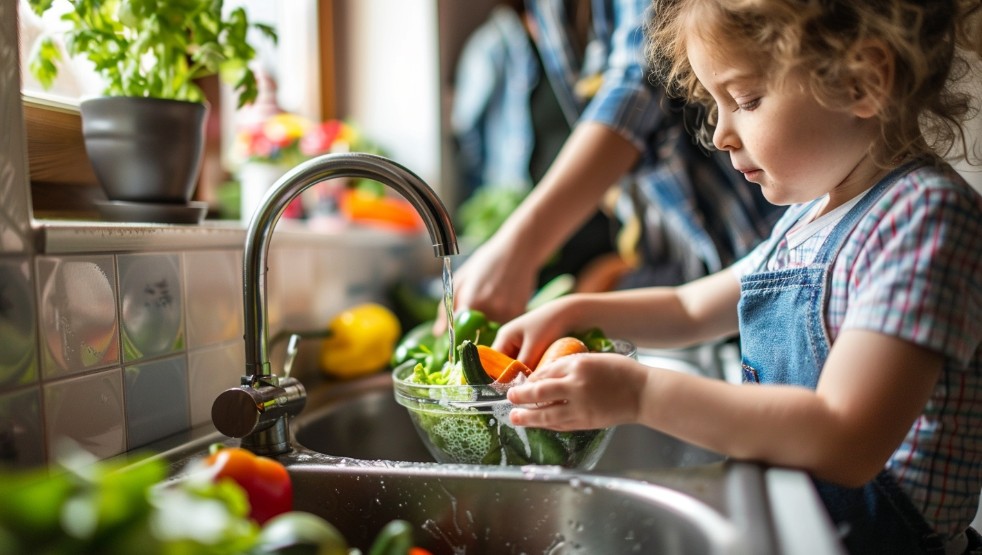
What kids can actually do in the kitchen: ages 3–4, 5–7, 8–12
I don’t love underestimating kids. They can often do more than we think. But overestimating isn’t great either—not out of fear, just common sense: coordination, patience, attention span. The trick is giving tasks where a mistake won’t turn into an injury.
Ages 3–4: short, simple, hands-on
At this age, kids switch gears fast. They want to touch, pour, smell, taste. Tasks should be tiny, with a clear “before and after.”
- wash fruit/veg in a bowl (not under a blasting tap);
- scoop grains with a spoon from one bowl to another;
- tear herbs or lettuce by hand;
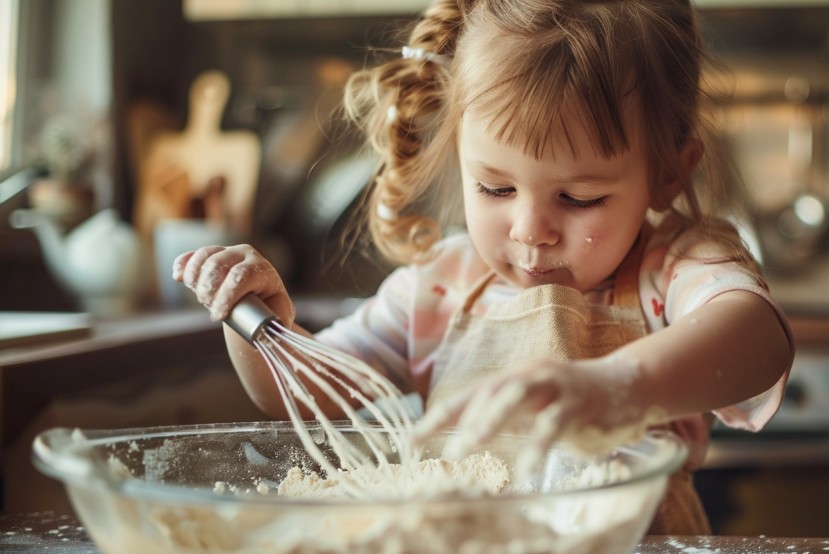
- whisk in a bowl (empty, or with something safe);
- set out napkins, place lightweight dishes on the table;
- “smell test”: spices in closed jars, tea, citrus zest.
Quick story: once a 3.5-year-old “helped” me with prep—her job was tearing salad greens. She’d tear two leaves and run to show her dad. This isn’t about productivity. It’s about the kitchen becoming a place where she feels seen and included.
Ages 5–7: rules start to stick, and pride kicks in
Now kids can follow a sequence: “first this, then that.” They want a real role. And they can remember 2–3 consistent safety rules—if you don’t change them every day.
- mix ingredients in a bowl, knead with their hands;
- weigh ingredients on a scale (with you nearby, but it feels like magic to them);
- portion ingredients into small bowls, sort things;
- peel hard-boiled eggs, mandarins, bananas;
- use a kid-safe knife for soft foods (if you’re into that) or a plastic training knife—only in the calm zone;
- wipe the table after cooking as part of the game, not as punishment.
Tip: ages 5–7 love having “your station.” A small board, a bowl, a cloth—and they feel like a cook, not a visitor.
Ages 8–12: you can teach responsibility without pressure
This is when kids often want to do it “for real.” And they can. The important part is not dumping adult anxiety on them: “Just don’t mess it up.” Make a deal instead: you’re responsible for hot and sharp; they’re responsible for prep, tidiness, and simple steps.
- slice soft fruit/veg with a proper knife, with clear rules and you present;
- use a grater with a hand guard or a cut-resistant glove (if you have one), and only when you’re right there;
- work with the oven together: you open it, they place/remove the tray at a safe distance, wearing oven mitts;
- clean the station “like a chef”: wipe, wash, put away;
- help plan a shopping list for simple meals (no need to turn it into a project).
Quick story: a 10-year-old once told me, “I want to cook like you—so it sizzles.” We agreed: sizzling only happens when I’m standing next to him, and he’s in charge of prep—patting ingredients dry so the pan doesn’t spit, and keeping the counter organized. He got his sizzle; I got my calm.
By the way, once your child has their own little “kitchen station,” salads are a perfect first thing to make together. Here are 10 of the best salads that are easy to prep with kids—no complicated techniques, and lots of steps where they can genuinely help.
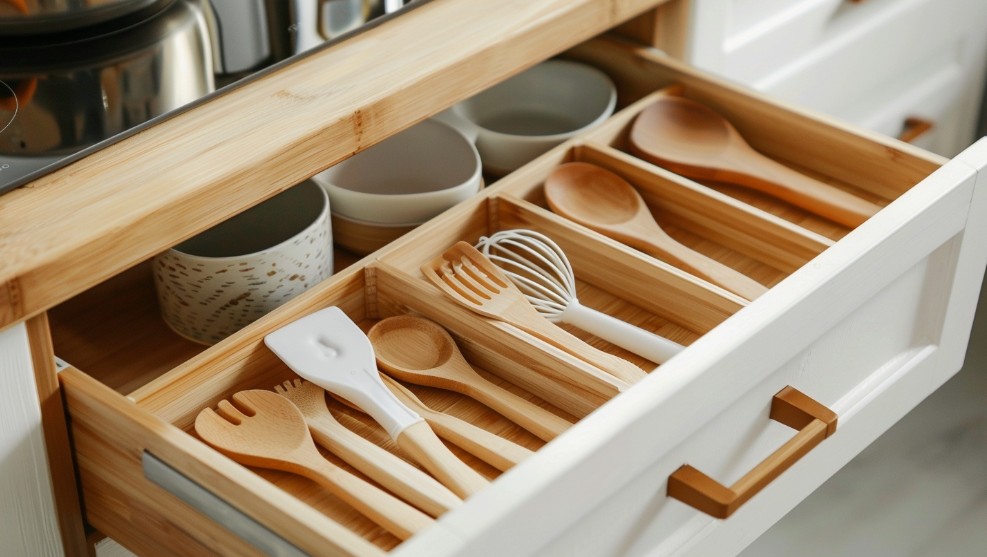
Storage and access: what goes up high, what can go down low
Organizing a kitchen with kids isn’t about buying a mountain of containers. It’s about access logic. If a child can reach something dangerous, they will—eventually. If they can’t, you stop living like a security guard.
What definitely shouldn’t be down low
- knives, scissors, graters, mandolines;
- glass bottles of oil/vinegar if they’re easy to knock over;
- cleaning products (ideally in a separate cabinet with a child lock);
- lighters, matches, gas canisters;
- very hot sauces/spices a child might “taste” with a spoon.
I know—sometimes the kitchen is tiny and “up high” is already full. In that case, another trick works: lidded boxes. Put the risky stuff in a box with a lid that’s boring to open or simply difficult. Not as a dramatic “forbidden” thing—just normal storage.
What you can give your child access to down low
This is the gold. When kids have a legal “yes,” they’re less likely to go hunting for a “no.”
- plastic or metal mixing bowls you don’t mind;
- silicone spatulas, whisks, wooden spoons;
- cookie cutters, simple measuring spoons;
- napkins, trivets, lightweight containers;
- an apron and a small cloth for “their” zone.
Tip: make one “kid drawer.” Not perfect, not Instagram-pretty—just theirs. It prevents so many conflicts.
About chairs and step stools (and why they matter more than you think)
Kids in the kitchen are almost always reaching up. If they don’t have a stable way to do it, they’ll invent one: stool on stool, a slippery chair, socks on tile. I’m firmly in the “one solid step stool” camp—stable, heavy, with a wide platform. And one rule: we stand only on that. Not on rolling chairs, not on upside-down boxes.
I don’t scare kids with fall stories. I just say it plainly: “This one holds you steady. The others wobble.” They understand that with their bodies.
Safety without the fear: simple rules that actually sound normal
I’m not a fan of “never-ever” rules. They fall apart the first time emotions run high. What works are short, repeatable phrases you can say without anger.
These are the ones I’ve seen stick best in real families:
- Hot things are only with an adult. Not a ban—an agreement.
- Knife down, blade facing away. And we don’t walk around the kitchen holding a knife.
- Wet hands don’t touch outlets or appliances. We just dry them.
- Look first, touch second. That’s awareness, not fear.
- If something spills—stop. No running, no “I’ll do it!” Pause and grab the cloth.
Quick story: a friend of mine has two kids, and they use the phrase “kitchen stop.” Not as punishment—more like a signal: “this is a risky moment, freeze.” She uses it when she’s draining boiling water or pulling out a hot tray. The kids don’t take it personally because it doesn’t sound like “you’re bad,” it sounds like “we’re in this mode for 20 seconds.”
One more thing I love: explaining through sensations. Not “because I said so,” but “because it’s hot/painful/slippery.” Kids think with their bodies. “Steam is invisible, but it burns” lands so much better than “don’t go there.”
Common adult mistakes (and how to fix them without beating yourself up)
I’ve seen these mistakes hundreds of times—and I’ve made them myself. They don’t mean you’re a bad parent. They usually mean you’re tired and trying to get things done faster. But they’re also the moments where accidents happen.
Mistake #1: “Just for a second” near something hot
The riskiest situations don’t happen when you’re focused—they happen when you’re “just for a second”: you turn to grab a plate, and your child is suddenly right by the stove. If a child is in the kitchen, I try to either place hot things where they physically can’t reach, or call “kitchen stop” and make sure they actually stopped.
Mistake #2: a pan handle sticking out
Classic. An adult walks by—bumps it. A child walks by—bumps it. Handle turned inward, and half the risk disappears.
Mistake #3: cleaning products “somewhere there, but closed”
“Closed” doesn’t mean inaccessible. For kids, the whole point is often “what’s inside.” If you can’t move cleaning supplies out of the kitchen, give them one dedicated spot—ideally with a child lock. And don’t store them next to food containers; kids recognize shapes faster than labels.
Mistake #4: scolding for a mess you allowed
You invited your child to “help,” handed them flour—and now flour is everywhere. If you don’t have the bandwidth for cleanup, it’s better to give a different task. Getting yelled at for the consequences of “helping” kills the desire to be near you. I prefer building cleanup into the process from the start: not “you made a mess,” but “let’s gather our crumbs.”
Mistake #5: instructions that are too complicated
Kids don’t hold ten steps in their head. One step, then a pause. “Pour it here”—done. “Now stir”—done. It’s slower, but calmer and safer.
Tip: if you catch yourself saying “I told you!” it usually means the rule was too long—or it never became a habit. Shorten it and repeat it calmly.
Noise, mess, spilled water: how to stay calm and not ruin the moment
A kitchen with kids sounds different. Things drop, things bang, someone sings, someone asks to do it “one more time.” That’s normal. The goal isn’t perfect silence. The goal is making sure noise and mess don’t turn into danger.
Spilled water isn’t a tragedy—it’s a script
I always keep one cloth or paper towels within reach. Not “somewhere in a cabinet,” but actually nearby. Because when water spills, you don’t want to run around—you want to stop the slipping.
- Say “stop” (no yelling).
- Move feet away from the puddle.
- Wipe it up together.
And yes, your child will wipe it imperfectly. That’s fine. What matters is they feel: “we can handle it,” not “I ruined everything.”
Counter mess: a boundary works better than comments
A tray, a big board, a silicone mat—anything that creates an edge. Kids keep order more easily inside a boundary. It reminds me of a sandbox: the sand is supposed to be “there,” and then it’s not everywhere (well, almost).
Running and chaos: agree on “paths”
If your kitchen is a pass-through, I like a simple agreement: “We don’t run here.” Not “don’t run,” but “run in the hallway/living room.” In the kitchen, we walk. Kids do better with an alternative than with a blank stop sign.
Quick story: friends of mine have two kids and a kitchen that feels like a train station. They taped a temporary line on the floor with painter’s tape—kids don’t cross it when something hot is happening. Not magic, but a visual boundary works better than repeating “step back” a hundred times.
Small habits that make the kitchen kid-friendly: 7 practical tips
Nothing heroic here. It’s the small stuff that creates that “attentive without fear” feeling.
- One stable step stool for your child. One rule: only that.
- A tray or mat as the “work zone”—fewer crumbs, fewer nerves.
- A cloth within reach, not “somewhere.” Spill—wipe—move on.
- Handles turned inward always, even when your child is “in the other room.” They can show up quietly.
- A separate kid tool set (bowl, spatula, whisk). Not fancy—just theirs.
- Visual boundaries: “this side of the counter is yours,” “don’t cross this line when it’s hot.”
- Short signal phrases: “kitchen stop,” “hot things are with an adult,” “wet hands—dry them.”
One more small thing I swear by: when a child does something helpful (even tiny), I don’t just say “good job.” I name what worked: “Nice—you wiped the water right away, so it’s not slippery,” or “Thanks for putting the spoon on the tray—nothing’s falling.” It’s not judging the child; it’s reinforcing the skill.
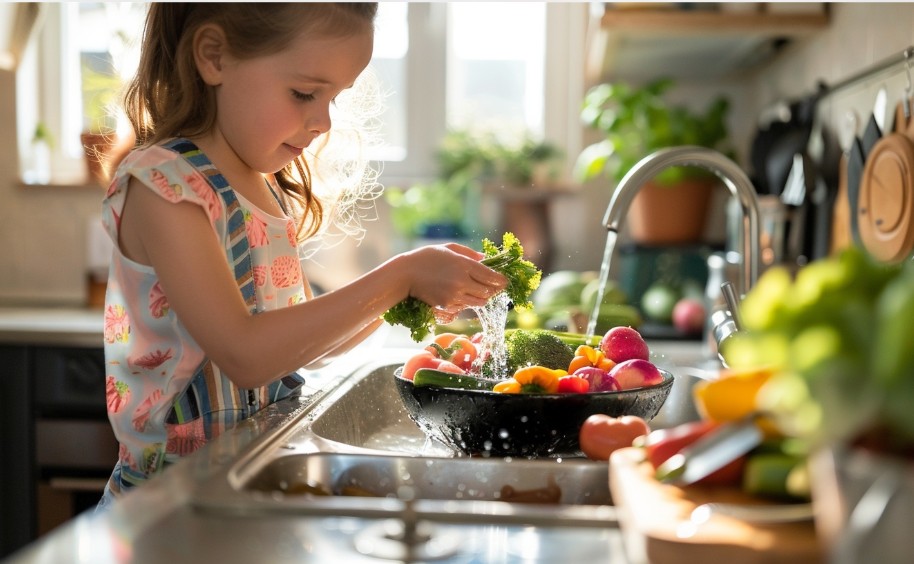
The emotional payoff: what kids (and we) take away from cooking together
I’ve watched kitchens turn into places of trust. Not because a child “learned to cook,” but because they were allowed to be close and do something real. When a kid kneads dough and laughs because it sticks to their fingers, when they sniff cinnamon and make a face, when they seriously wipe up a puddle because “we agreed”—that’s not about perfect cleanliness. It’s the feeling of: “I’m allowed to be here.”
And for adults, it’s a gift too. You stop being the kitchen guard and become a partner. Yes, it’s slower. Yes, it’s louder. But you get warm memories that somehow stick for years: the rustle of flour bags, the spoon tapping the bowl, the smell of apple and vanilla, and a small person carrying their own plate to the table—carefully, tongue out in concentration.
I’m curious: what’s the most stressful part of having kids in the kitchen with you—hot stuff, knives, the mess, or the feeling that you can’t get anything done? And what already works in your home, even if it’s not perfect?