A Light Dinner That Doesn’t Make You Sleepy


It’s a bit strange that dinner is always such a dilemma. You come home, the day has been different: for some, it’s chaos, for others, it’s cozy, but fatigue is felt everywhere. And then there’s this question: what to eat for dinner, how to make it filling yet not heavy, and avoid being overwhelmed by drowsiness when you still want to do something for yourself, spend time with family, and not just ‘switch off’ on the couch until morning?
I’ve been searching for this balance for a long time: to eat but not overeat, to feel light and not think about food for another two hours. There are periods in life when dinner is just ‘something to eat,’ and times when you want to care for yourself even in the smallest things. And also, the desire not to scold yourself for your choices. Food should be a support, not another stressor. Especially in the evening, when everything around finally slows down.
So this conversation is about the attitude towards dinner, about habits that work in real life, and about how to give yourself peace instead of guilt. Because perfect dinners don’t exist, and lightness is not about products with labels, but about balance and a bit of common sense.
Why Even Think About Dinner?
Dinner is not just another meal. For many, it’s the moment when the day ends, when you can finally exhale, take off all roles, forget about deadlines or endless calls. And for some, it’s also a little home celebration: gathering the family, discussing how the day went, or just being together at one table.
But there’s another side: evening meals sometimes become a source of unnecessary stress. Especially when you eat on the run, ‘catch up’ after a missed lunch, or when there’s a voice in your head saying: “don’t eat this, don’t eat that.” A familiar story — you eat, and then feel guilt, heaviness, or drowsiness that overwhelms you.
I’m familiar with evenings when I just wanted to throw something in to ‘fill’ the fatigue. And there were times when dinner became a reason to punish myself: either by strictly limiting myself or, on the contrary, allowing myself everything after a hard day. Neither option brought relief.
At some point, I realized: dinner is not about food as such. It’s about how to close the day. How to take care of yourself, not overdo it, and not reduce everything to prohibitions or rituals.
Why Do You Feel Sleepy After Dinner?
There’s a difference between that pleasant fatigue when the body relaxes after a hearty but light meal, and the one that literally knocks you off your feet. Often the reason is simple: overeating, too heavy food, or a sharp drop in energy after ‘fast’ carbohydrates.
I remember one of the work shifts when after dinner in the kitchen (and it was a classic — pasta with meat, a piece of bread, and ‘something sweet’), I just shut down at the table. Then I couldn’t get back to work for a long time, feeling slow and inattentive. And it lasted for more than an hour.
- Overeating is the main cause of heaviness and drowsiness after dinner.
- Heavy foods (fried, fatty, lots of protein) stay in the body longer.
- A sharp change in blood sugar levels after sweets can cause fatigue.
But here’s the important part: you don’t need to fear pasta, meat, or even dessert. It’s not about ‘banning’ them, but about how to combine them and how much to take. I stopped counting portions but learned to distinguish when I’m comfortable and when it’s too much.
If during dinner you catch yourself thinking you’d eat a little more — that’s normal. But when you don’t want to move anymore — that’s a signal to stop.
Sometimes a simple life hack works: eat slower, take breaks, don’t get distracted by the phone. When you focus on food, it’s easier to feel when it’s enough.
Everyday Scenarios: When Dinner is Just Survival
Ideally, dinner is a beautiful plate, quiet music, family nearby. But often it’s different. You come home from work, the kids demand attention, someone hasn’t finished their homework, and the fridge hints that today is improvisation. In such moments, it’s easy to fall into two extremes: either grab something on the go (sandwiches, leftovers from lunch, cookies), or cook for a long time and then overeat because you’re very hungry.
I remember evenings when the only dinner was cold rice with leftover chicken because there was no strength to cook. And in these moments, it’s important not to scold yourself for an ‘improper’ dinner. It’s just life.
Parents know the story: while feeding the kids, you grab something quickly or finish their leftovers. It’s easy to lose a sense of measure here. It’s on such evenings that I discovered that it’s not a recipe that saves, but a simple rule: better less, but with attention to yourself.
- Don’t rush: even 5 minutes of silence instead of the phone already changes the attitude towards food.
- If you’re very tired — choose something light but familiar. A familiar taste calms.
- A small portion is your friend. Better to add more than regret the excess.
And another story. In one kitchen, when we cooked for a large company, there were always a lot of leftovers: pieces of vegetables, leftover grains. I learned to make ‘dinner out of nothing’ — and it wasn’t about perfection, but about comfort. The main thing is not perfection, but the feeling that you took care of yourself.
Guilt-Free Dinner: How Not to Scold Yourself for Choices
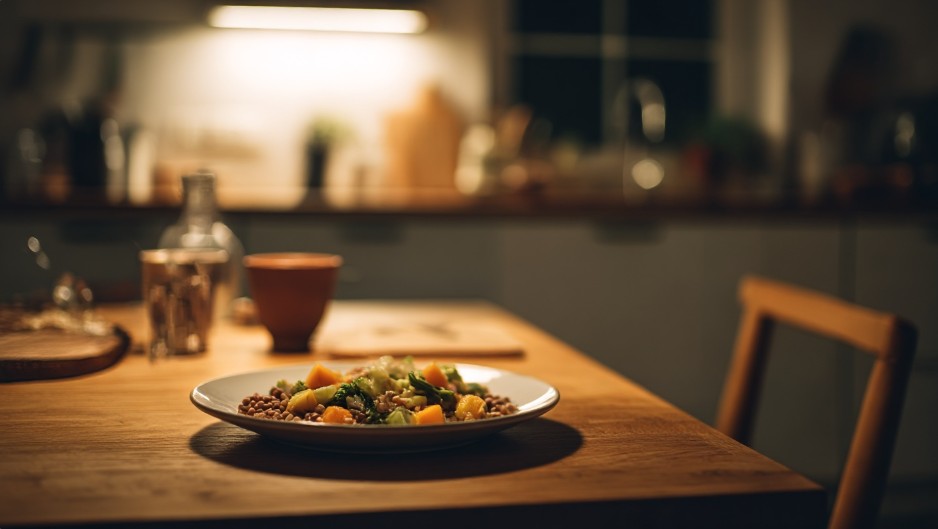
Guilt is what most often spoils the relationship with food. Especially in the evening, when the day was hard, and it seems like ‘I should have chosen better,’ or ‘I ate the wrong thing again.’ I lived with this feeling for a long time, and it never helped. On the contrary, tension appeared, and food stopped bringing joy.
It’s important not to succumb to the myth that there is ‘right’ food for dinner. Dinner is not an exam. You don’t need to report to an imaginary dietitian. You can just allow yourself to relax and eat what you really want, without unnecessary control.
I felt relief when I allowed myself to eat in the evening what suits me now — even if it’s not ‘healthy’ according to some books. Over time, I noticed: the less pressure, the easier it is to make a light choice.
- Don’t ban yourself from foods: it only increases the craving.
- Allow yourself imperfection: dinner is not a competition.
- Remember: satiety and lightness are about feelings, not labels.
Sometimes a simple trick helps me: before dinner, ask myself — what do I want now? Maybe it’s a salad, maybe something warm. You don’t always have to eat ‘light’ if you want warmth or coziness.
Habits That Work in Real Life
Dinner is not a place for big experiments. Here, it’s not rules that work, but habits. When you do something regularly, it becomes part of life, not some kind of extra effort.
I noticed that a few simple habits change the feeling of dinner:
- Eat slowly. It’s not about etiquette — it really helps to stop when you’re full.
- Listen to yourself: if today you want more — okay, as long as it’s comfortable.
- Plan a light dinner in advance (at the level of ‘what’s in the fridge’), so you don’t grab on the go.
- Don’t eat in front of a screen — it’s easier to feel when it’s enough.
One of my friends, who works 10 hours a day, always leaves something light from lunch for herself. She says: ‘If I’m very tired in the evening — I’ll eat a little, and that’s enough not to fall asleep immediately.’ It’s not about strict rules, but about taking care of yourself.
The best habit for dinner is to be attentive to your feelings, not to lists of prohibitions.
How Not to ‘Break Down’ in the Evenings: Flexibility Instead of Restrictions
Breakdowns happen when you limit yourself all day, and in the evening ‘allow everything.’ It’s a trap I’ve fallen into more than once. Strict rules during the day, and then — ‘finally, I can’ and overeating. After that — guilt and promises to ‘change everything tomorrow.’
I noticed that flexibility works better than control. If during the day you allow yourself to eat hearty and varied, in the evening there’s no desire to pile everything on at once. It’s not about permissiveness, but about a healthy balance.
Here are a few life hacks that help me not to ‘break down’:
- Allow yourself small joys throughout the day, so you don’t compensate in the evening.
- Don’t stay hungry until late — a light snack after lunch really helps.
- If the day was hard — don’t punish yourself with food, try to make dinner cozy.
One evening I caught myself opening the fridge for the third time, not knowing what I wanted. I stopped, drank a glass of water, sat for 5 minutes, and realized: I just lack warmth and silence, not food. Sometimes it helps to ask yourself: ‘Am I really hungry or just want to relax?’
Texture, Aroma, Appearance: How Dinner Affects Feelings
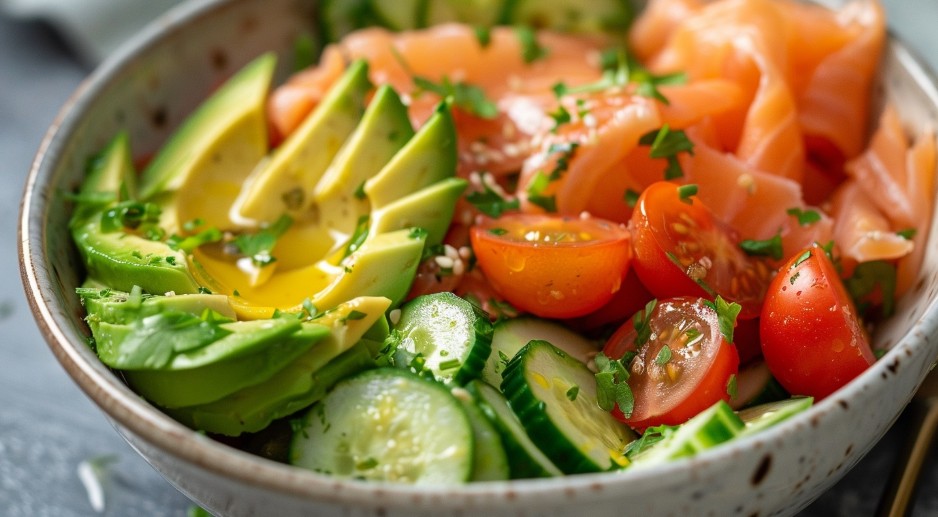
Food is not only about calories or ‘correctness,’ but about feelings. Dinner becomes lighter if it has something fresh, crunchy, aromatic. It can even be a simple dish: warm vegetables with a light aroma of oil, a handful of greens, a piece of cheese, or toast with your favorite sauce.
I love when there’s something combined on the plate: soft and crunchy, a bit of warm and a bit of fresh. For me, it’s like a signal: dinner ends not because I’ve eaten everything, but because I’ve enjoyed it.
In summer, I like light vegetables — the smell of fresh cucumber or basil literally refreshes. In winter — something warm, like stewed vegetables or puree soup. The main thing is that dinner is not monotonous, but evokes a desire to taste, not just ‘fill’ the stomach.
- Add greens or lemon juice — it refreshes.
- Play with textures: combine soft and crunchy, warm and cool.
- Pay attention to the smell: the aroma of fresh food helps you feel full faster.
I noticed that if dinner looks appetizing — even the simplest portion brings more satisfaction. It’s a simple way to make dinner lighter without any restrictions.
Common Evening Eating Mistakes
We all make mistakes — it’s normal. It’s important not to scold yourself, but just to notice and try differently. Here are the most common mistakes I’ve seen both in myself and in kitchens where I’ve worked:
- Overeating ‘at night,’ trying to compensate for missed meals during the day. It’s classic: in the evening, you pile on everything you have, and then heaviness and drowsiness.
- Eating ‘on the go’ or in front of a screen. Distraction takes away the sense of measure, and it’s easy to eat more than necessary.
- Fear of certain foods. If you think ‘this is not allowed,’ then you eat twice as much later. It’s better to allow yourself a little than to forbid and break down.
- Ignoring the feeling of satiety. Sometimes we eat ‘on autopilot,’ not noticing that we’re already full.
I’ve caught myself more than once eating quickly after a stressful day, not tasting the food. After that, there was a feeling that the evening was wasted. Now I try to take a pause between portions — it helps to catch the moment when it’s enough.
Mistakes are not the end of the world. Next time, just listen to yourself a little more attentively.
Dinner for Different Days: How to Adapt for Yourself
There is no universal formula for a light dinner. Sometimes after an active day, you want a little more, sometimes a light snack is enough. The main thing is not to demand consistency from yourself.
When there’s a lot of physical work, the body asks for more hearty food — that’s normal. After a calm day, a light salad or soup is enough. I’ve learned not to compare my evening choices with others. It’s important to listen to the body, not books or internet advice.
- Days when you want more — not a problem. Just choose options that are easily digestible.
- Days when there’s no appetite — that’s okay too. Don’t force yourself.
- If there are still things to do ahead — choose dishes that don’t cause heaviness (e.g., vegetables, a bit of protein, something warm).
I love experimenting with what’s on hand. An evening when there are only a couple of eggs, a piece of cheese, and a cucumber in the fridge is perfect for improvisation. You don’t need anything special to avoid feeling heavy.
Practical Guidelines: How to Maintain Lightness and Satisfaction
In conclusion, a light dinner is not about a list of ‘what’s allowed,’ but about the habit of listening to yourself and not punishing yourself for your choices. A few things that help me:
- Enjoy the process: even a simple dish becomes better when you eat it slowly.
- Pay attention to taste, texture, aroma — this increases satisfaction and reduces the need for a large portion.
- If you don’t want to eat — don’t force yourself. Lightness is also about refusing food when there’s no appetite.
- Cook simple but with love for yourself. It’s more important than any ‘diet rules.’
I’ve come to realize: evening lightness is not about what you ate, but about how you approached it. Sometimes it’s enough just to pause and allow yourself to feel that it’s already good.
To sum up: the best dinner is one after which you don’t want to fall asleep from heaviness, but you’re not left hungry either. It’s about balance between body and mood.
How do you feel about dinner? Do you have your little tricks that help you stay in shape after an evening meal? Share in the comments — it’s interesting to read your real-life stories.