How to Make the Perfect Caesar Salad: Step-by-Step Technique


Have you ever bought a Caesar salad at a café, and everything seems perfect: crispy croutons, fresh lettuce, tender dressing? But at home, something goes wrong. The leaves are wilted, the chicken is dry, or the dressing just isn’t ‘right.’ I remember the first time I took an ‘iceberg’ out of the fridge, chopped it, tossed it in a bowl, poured some mayonnaise over it, and waited for a miracle. The miracle didn’t happen. Then I started to delve into every detail. It turned out: Caesar is not about complexity, but about understanding. In this salad, every little thing matters.
Until you feel the process, you won’t understand why something is done in a certain way—the result will always be ‘almost.’ But it’s these nuances that separate the homemade version from the one that is memorable. And the main thing is, it’s not about talent, but about attention and a calm approach. If you want not just to ‘repeat,’ but to feel in control and stop being afraid, this breakdown is for you.
What Defines the Perfect Caesar Salad?
Caesar is not just ‘a salad with chicken and croutons.’ It’s a trinity of textures, temperatures, and flavors. Freshness, crunch, piquancy, lightness, creaminess—all at once. The perfect Caesar doesn’t fall apart on the fork, doesn’t drown in dressing, and doesn’t turn into mush in 10 minutes. It gathers around itself: you want to eat more and more, not push the plate away after the first spoonful.
Everything here works for balance. If you slightly over-dry the chicken, the salad loses its tenderness. If the leaves are wet, the dressing doesn’t stick, and everything becomes watery. If the croutons are made ‘anyhow,’ they are either too hard or become soggy like a rag. I’ve often watched as kitchen novices nervously add more dressing because ‘it seems dry,’ or break the bread into tiny crumbs because it’s ‘more convenient.’ And then they wonder why the taste isn’t right.
A thin layer of dressing on each leaf, perfect chicken texture, crunchy but not stone-hard croutons—that’s what makes a Caesar truly delicious.
Each component is like a player in a team. If one fails, the dish ‘falls apart’ in impression. It’s not so much about doing it ‘by the recipe’ as it is about understanding why exactly, and how to fix it if something goes wrong.
Lettuce: Freshness, Preparation, and Temperature
Lettuce in Caesar is not just a backdrop. It should be the main carrier of freshness. I often see people pouring everything they have into the salad: iceberg, romaine, even napa cabbage. But if you want a really great result, it’s better to use romaine. Its structure holds its shape, the leaves are crunchy, and the taste is neutral with a slight bitterness. Iceberg will also work if there’s no romaine, but it ‘melts’ under the dressing faster.
The biggest mistake is assembling a salad from leftovers that have already wilted. The leaves should be dense, without dark spots and the ‘fridge’ smell. Wet leaves are another problem. The dressing slides off, and the salad becomes watery. I always wash the leaves in advance, let the water drain, then gently pat them dry with a towel. If I have time, I leave them in the fridge for 15–20 minutes in a large bowl, covered with a towel. The salad becomes crispy, cold—the perfect base for Caesar.
How to Know if the Leaves are Right?
Visually—they are not limp, not tearing in your hands. To the touch—cool, crunchy. If you break the stem, you hear a characteristic ‘snap.’ When you cut or tear them, the pieces should not be too small. Too small leaves quickly lose juiciness and draw more dressing than necessary.
Common Mistake
Many people tear the leaves ‘too small’ by hand, or, on the contrary, are lazy and put large pieces that are inconvenient to eat. Try to find your ‘medium’ size—so that the leaf fits on a fork but doesn’t get lost under the dressing.
Croutons: Texture, Crunch, Aroma
Croutons are a separate story. They often become the cause of disappointment. Store-bought ones are almost always too salty, with unnecessary flavorings, and lose balance. Homemade croutons are another matter. But the main thing here is not to over-dry them.
For perfect croutons, choose bread with a dense crumb: a baguette or just white bread from yesterday’s baking. Too fresh bread is hard to cut and quickly ‘melts’ in the salad. I cut the bread into cubes, gently drizzle with oil, add a bit of garlic, and mix by hand. Then—into the oven (180°C) for 10–12 minutes. Important: stir from time to time so they brown evenly. Don’t make the cubes too small—they will quickly become soggy.
How to Determine if Croutons are Ready?
A crouton should be golden, crunchy on the outside, but slightly soft inside. If you press it with your finger, you feel resilience, not ‘stone.’ When you take them out of the oven, they seem a bit softer, but once cooled, they become just right.
Common Mistake
Putting croutons in too hot an oven or over-drying them until they ‘gnaw on teeth.’ Then they don’t absorb the dressing but just crumble. Or cutting them too small—they become soggy instantly.
Tip: if the cubes have already become too hard, quickly fry them on a dry pan for a few minutes and let them cool—they will become crunchier but won’t be such ‘stones.’
Chicken: Tenderness, Temperature, Cooking
In Caesar, chicken is not just ‘something protein.’ It should be juicy, soft, with a distinct crust. Often at this stage, many lose confidence: ‘What if it’s undercooked?’, ‘What if I overcook it?’. I also caught myself making chicken ‘with caution,’ and getting dry pieces that I didn’t want to eat.
The golden rule: chicken fillet should be at room temperature before frying. If you take it straight from the fridge, the middle will remain raw, and the outside will already dry out. I always let the fillet sit for 15–20 minutes, meanwhile heating the pan. I add salt and pepper right before frying, sometimes a little olive oil.
Focus: place the fillet on a well-heated pan, don’t move it for 2–3 minutes. Then carefully flip it—and another 2–3 minutes. Then reduce the heat, cover with a lid, let it ‘reach’ under steam for another 3–4 minutes. Then—be sure to let the chicken rest for 5 minutes before slicing.
How to Check if the Chicken is Ready?
On the cut—no pink, the juice is clear. To the touch—resilient, not ‘rubbery.’ If you press with a fork, the juice doesn’t flow ‘in a stream,’ but just moistens the meat.
Common Mistakes
- Slicing the fillet while still hot—the juice flows out, the meat becomes dry.
- Frying on low heat—the chicken ‘boils’ instead of browning.
- Too thick pieces—the outside is already burnt, but the inside is raw.
If you still over-dried it—try slicing the chicken thinner and drizzling a little olive oil or lemon juice. It won’t return to perfection, but it will make the meat more edible.
Cheese: Role, Texture, What to Choose
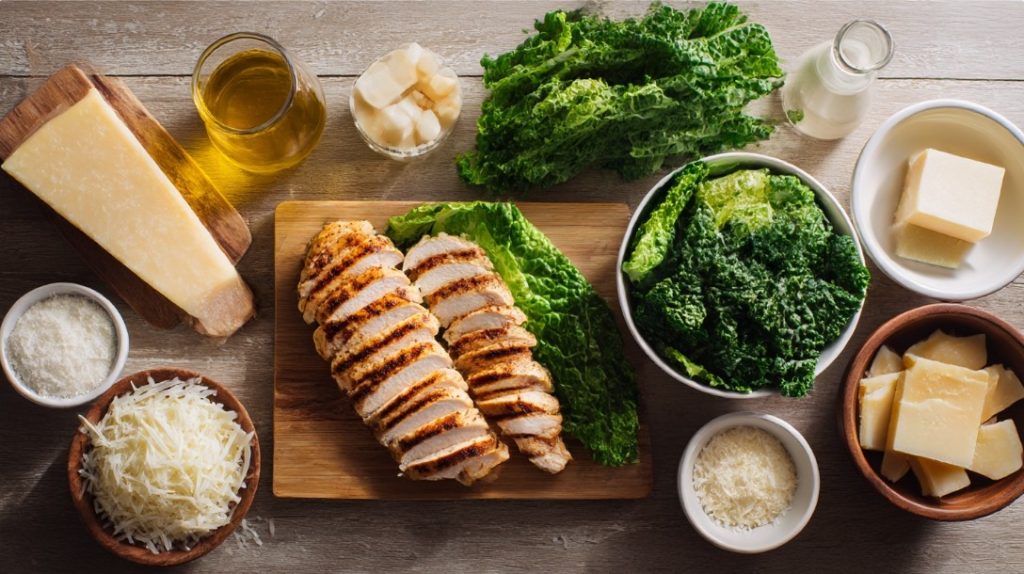
In classic Caesar, it’s Parmesan. But it’s not always possible to buy it. I’ve often used Grana Padano or even a good hard cheese with a pronounced aroma. The main thing is not to skimp on quality and not to take a ‘cheese product.’
Cheese in Caesar is not just ‘something salty on top.’ It adds piquancy, gives creaminess to the dressing, and perfectly combines with the crunch of croutons. Important: don’t grate the cheese too finely, but into thin slices or wide shavings. This way, it melts on the tongue, not disappearing in the dressing.
Tip: if you don’t have a special grater for shavings, try peeling thin slices with a vegetable peeler. It looks beautiful, and the taste is different—the cheese is felt separately, not as a ‘background.’
Common Mistakes
- Adding cheese ‘in reserve’ because it’s ‘tastier’—it disrupts the balance.
- Using too soft or sour cheeses—the taste becomes ‘strange.’
- Mixing cheese with dressing—loses structure, and the salad becomes heavy.
Caesar Dressing: Emulsion, Balance, Taste Sensation
This is the heart of the salad. This is where most fears lie: ‘the emulsion won’t work,’ ‘everything separates,’ ‘the taste isn’t right.’ I was also once afraid to whip the dressing because everything seemed complicated. But when I understood the logic, I realized it’s not about magic, but patience and understanding the process.
Caesar dressing is a combination of yolk, oil, mustard, anchovies, lemon juice, garlic, cheese. When these ingredients are mixed correctly, you get a creamy, tender emulsion. What is it? It’s when fat and liquid (oil and lemon juice) combine into a thick, homogeneous mass that doesn’t separate.
Why Sometimes the Emulsion Doesn’t Work?
- Yolk and oil are at different temperatures—the dressing doesn’t combine.
- Pouring oil too quickly—the emulsion ‘breaks.’
- Too much acid—the dressing is runny, doesn’t stick to the leaves.
I always start with all components at room temperature. Yolk, mustard, anchovies—all thoroughly mashed with a fork or whisk until smooth. Then I gradually pour in the oil—initially literally drop by drop, whisking quickly. As soon as the mass starts to thicken, you can pour faster. I add lemon juice at the end so as not to ‘break’ the emulsion.
How to Know if the Dressing is Perfect?
Visually—smooth, shiny, sticks to the spoon. To taste—a balance of fat, piquancy, salt, and acidity. If you run a spoon through the dressing, a ‘track’ remains, not disappearing immediately.
Tip: if the emulsion still ‘broke’ (separated), try starting a new one—whisk another yolk separately and gradually pour the separated dressing into it, constantly whisking. This often saves the situation.
Salad Assembly: Temperature, Sequence, Details
This is where the magic begins. Very often, it’s at the assembly stage that all efforts ‘burn out.’ The salad becomes wet, the croutons become soggy, the chicken is no longer appetizing. To avoid this, you need to follow a simple logic: everything is assembled at the last moment, right before serving.
I always make sure the leaves are completely dry and cold. The chicken is already cooled, but not cold from the fridge, but room temperature. The croutons have cooled but are still crunchy. The dressing is also not from the fridge, but fresh, room temperature.
Lifehack: mix the leaves with the dressing by hand, gently, so that each piece is thinly coated. Don’t pour—mix!
Common Mistakes
- Assembling the salad ‘in advance’—the leaves wilt, the croutons become soggy, the taste ‘disappears.’
- Layering the ingredients—instead of a cohesive taste, you get a ‘divided’ dish.
- Adding too much dressing—the salad becomes heavy and watery.
Another detail: don’t pack the salad into the bowl. It’s better to gently mix and serve immediately. And don’t be shy to taste it right during assembly—it’s easier to adjust the balance.
How to Fix It if Something Goes Wrong
We all make mistakes. The main thing is not to panic and not to throw efforts into the trash. Here are a few typical situations and what to do with them:
- The dressing separated: try whisking another yolk and thinly pouring the separated dressing into it, without stopping whisking. Or add a few drops of warm water and whisk again.
- The chicken is dry: slice thinner, drizzle with oil or lemon juice, mix with the salad—not ideal, but better than in pure form.
- The croutons are too hard: briefly fry in a pan or drizzle with water and let stand for a few minutes—they will soften.
- The leaves are wilted: soak in ice water for 10 minutes, then let dry—this often returns the crunch.
- The salad is ‘floating’: quickly drain the leaves, pour off excess liquid, add some new croutons, and mix again.
I had a case when at a corporate event, 10 minutes before serving, it turned out that the dressing ‘broke.’ I quickly whisked a new yolk, added the old dressing in small portions—and saved not only the salad but the team’s mood. Don’t be afraid to experiment and fix it—this is also part of the practice.
Feelings: How It Should Taste, Feel, and Look
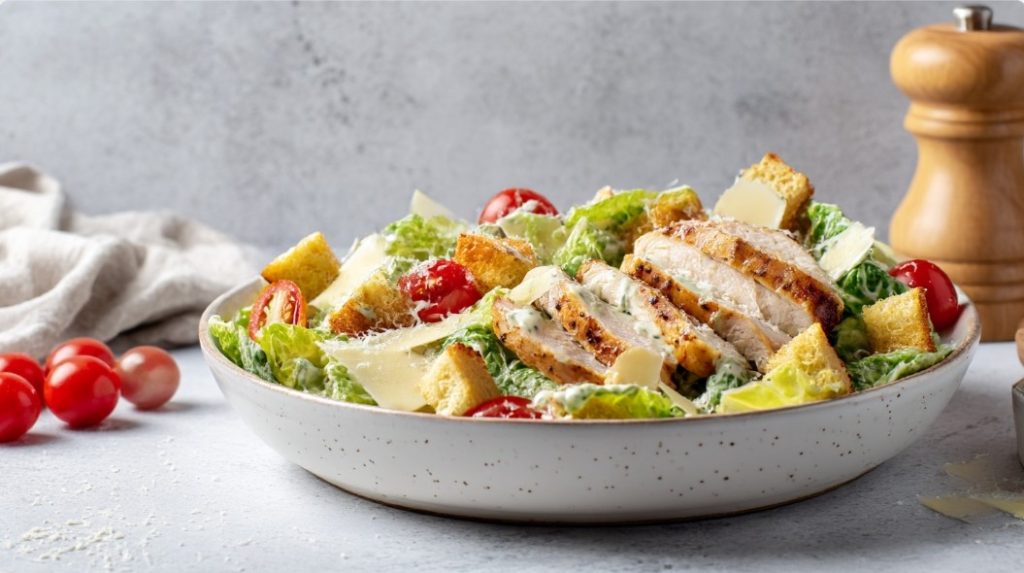
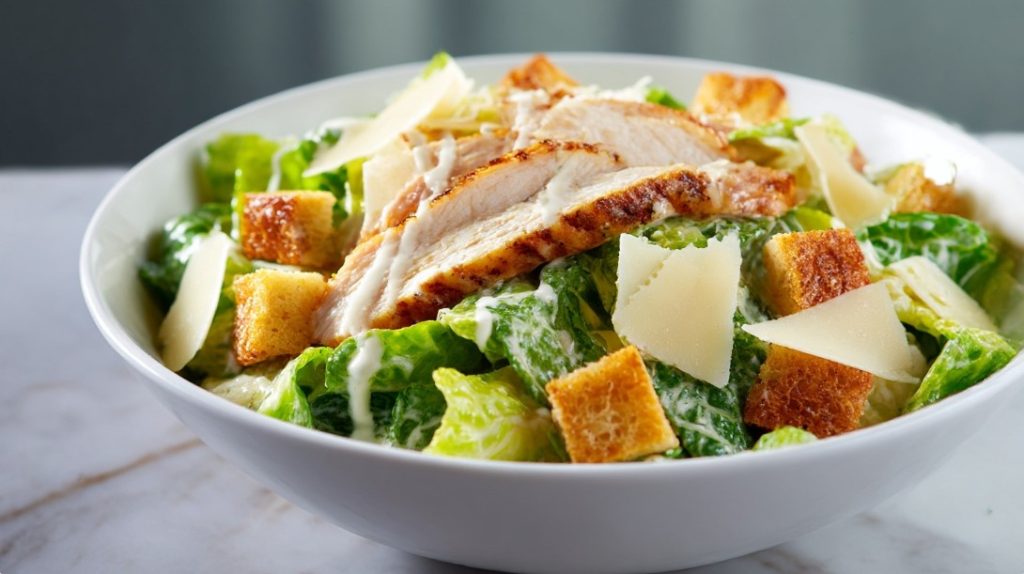
Last but not least—your own feelings. The perfect Caesar is when you take a fork, and there: crispy, cold leaves, warm or room temperature chicken, croutons that haven’t become soggy, dressing that coats, not drowns. To taste—a balance of acidity and piquancy, a slight aroma of garlic, a light salty aftertaste from the cheese.
When the salad is assembled correctly, you feel several layers in each piece: crunch, softness, creaminess. There’s no ‘mush,’ no feeling of fat or excessive acidity. I’ve often caught myself wanting to eat a good Caesar slowly: the taste unfolds gradually, there are no ‘sharp corners.’
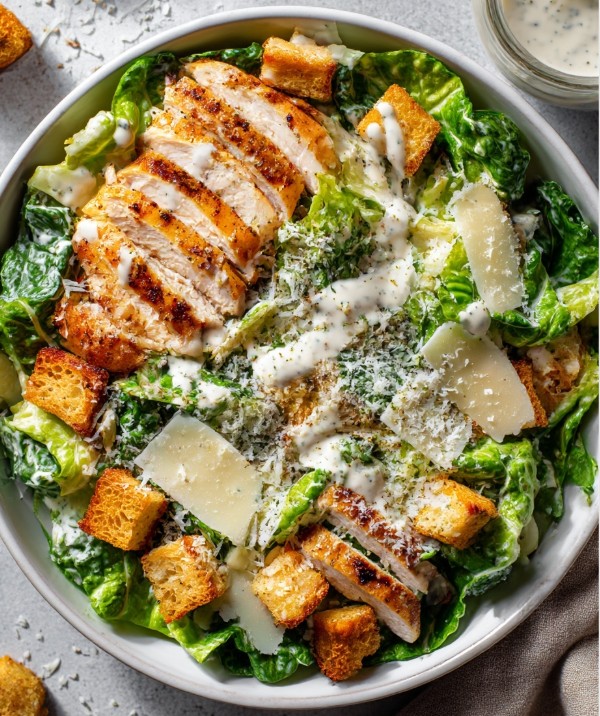
Visually—the salad doesn’t look overloaded. The color of the leaves is bright, the cheese shines, the croutons are golden. The dressing is a thin layer, not ‘spots.’ If it’s all like this—congratulations, the result is no worse than a restaurant’s.
Why You Shouldn’t Be Afraid to Experiment
Caesar is not a formula, but a set of principles. If suddenly something is missing—don’t fret. Once, when I was learning, I didn’t have anchovies for the dressing, and I used a few drops of Worcestershire sauce. It turned out differently, but still delicious. Don’t be afraid of ‘ruining’ it—every experience adds confidence.
The main thing is to understand the logic: why you need to dry the leaves, why wait for the chicken to cool, how the emulsion works. If you feel this—no salad will ruin the evening. And even if something doesn’t turn out perfectly—you’ll have an understanding of how to fix it.
Don’t chase ‘correctness,’ listen to yourself and don’t be afraid to experiment. Then even the simplest dish can be made ‘your own’ and truly delicious.
Making Caesar is not about complex recipes, but about feeling control and enjoying the process. Don’t be afraid to make mistakes, experiment, observe changes in textures and flavors. How did you first dare to make Caesar at home? What surprised you the most? Share your experience in the comments—it’s interesting how it was for you.
If you want more salads, here’s our holiday collection.